
How to See What Buyers Ask AI About Your Category
Jul 07, 2026
Here is the uncomfortable truth first: you cannot see the queries. There is no Search Console for chatbots, no keyword report for AI assistants, no dashboard anywhere that shows you what buyers in your category typed into an AI tool last month. The single fastest-growing research behaviour in B2B buying is, for now, a black box.
And it matters more every quarter. G2's 2026 research found 51% of B2B software buyers now start their research in an AI chatbot more often than Google, and Forrester reports 94% of business buyers using AI in their buying process. The questions are being asked. You just cannot watch them being asked.
But you can get close, and closer than most of your competitors are bothering to. This guide covers four practical methods for working out what buyers are asking AI about your category, and a monthly routine that turns them into a repeatable measurement. None of them needs a new platform. Together they take about an hour a month.
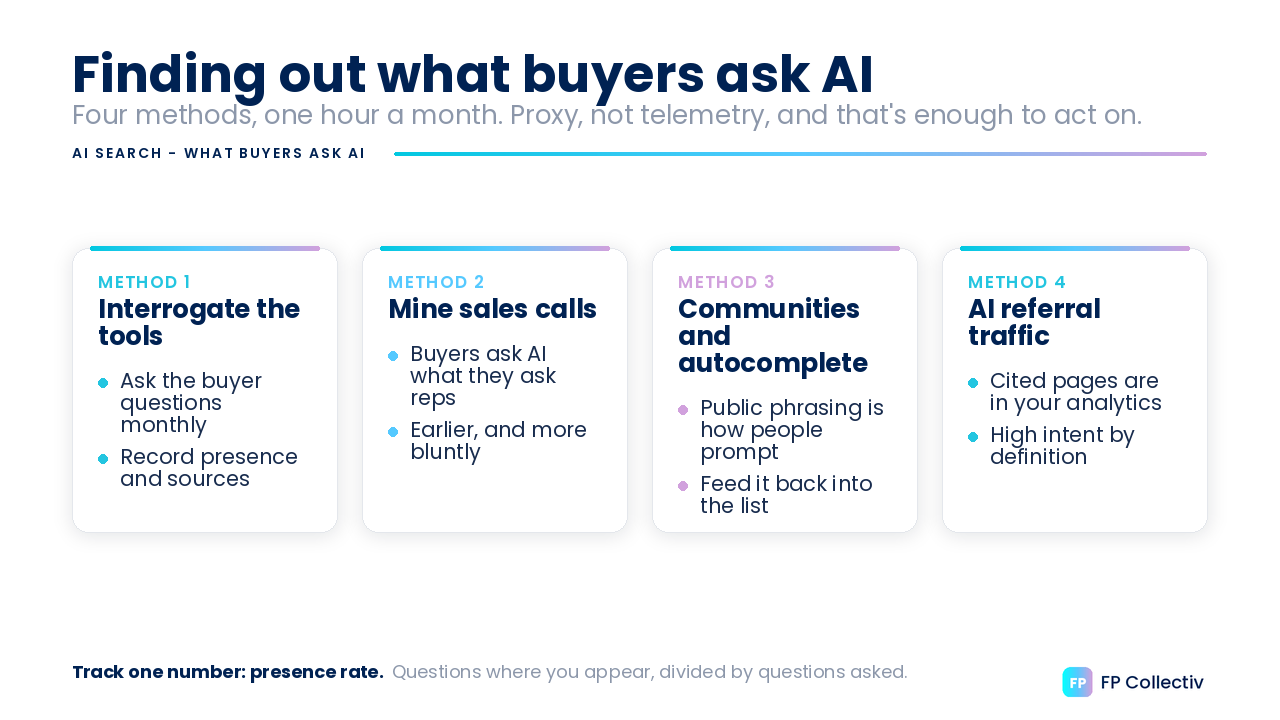
The four methods
Finding out what buyers ask AI
1. Interrogate the tools yourself.
Ask the buyer questions monthly; record presence, sources and framing.
2. Mine your sales conversations.
Buyers ask AI what they ask your reps, just earlier and more bluntly.
3. Harvest communities and autocomplete.
Public question phrasing is how people prompt.
4. Watch your AI referral traffic.
The pages already earning citations are sitting in your analytics.
Method 1: Interrogate the AI Tools Yourself
The most direct window into AI answers is asking the questions yourself and studying what comes back. You will not see real buyers' queries, but you will see exactly what a buyer asking those questions would be told, and that is the part you can act on.
Step 1: Build your question list (15 to 20 questions). Write the questions a buyer in your category would plausibly ask at each stage: the naive early questions ("what is [category]?", "do I need a [category] tool?"), the comparison questions ("what should I look for in a [category] platform?", "how do I choose between approaches to [problem]?"), and the validation questions ("is [approach] worth it?", "what are the risks of [approach]?"). Write them in plain buyer language, not your internal jargon; buyers prompt the way they talk.
Step 2: Ask them in the tools your buyers actually use. Run the list through four or five of the major AI assistants and AI-powered search engines, in fresh chats with no custom instructions, one question per chat. Where a tool offers a web-search mode, use it; that is the mode that reflects the live web your content competes in.
Step 3: Record three things per question, per tool. Whether your brand appears at all. Which sources get cited (the top two or three domains). And how the answer frames the decision, because the framing tells you what the models have absorbed from the existing content in your category.
You're done when: you have a simple grid of questions against tools, with presence, sources and framing filled in. That grid is your baseline, and everything below feeds it.
Method 2: Mine Your Sales Conversations
Buyers ask AI the same questions they ask your salespeople. The difference is sequence and bluntness: they ask the AI earlier, and they ask it things they would be too polite or too guarded to ask a rep.
So your discovery calls, demo Q&As and objection logs are a proxy corpus for AI queries in your category. Pull the last two or three months of call notes or recordings and extract every genuine question a buyer asked, in their words. Strip the pleasantries and you will find the same fifteen questions recurring, phrased three or four ways each.
Two refinements make this sharper. First, weight the early-stage questions most heavily; those are the ones migrating to AI fastest, because they are the ones buyers now resolve before they ever contact a vendor. Second, note the questions reps hear less often than they used to. A question that used to open every discovery call and has quietly disappeared did not stop being asked. It moved.
Method 3: Use Communities and Autocomplete as Seed Lists
The phrasing people use in public forums is remarkably close to how they prompt AI tools: plain, specific, and slightly exasperated. That makes marketing and industry communities a free corpus of real question language.
Spend twenty minutes in the forums and subreddits where your category gets discussed and collect the actual question titles: not to answer them (though you should, that is its own channel), but to harvest the phrasing. Add classic search-intent sources on top: search engine autocomplete for your category terms, the "people also ask" boxes, and the related-searches footer. These were built from query data, and AI prompts are their conversational cousins.
Feed the best of these back into your Method 1 question list. The list should evolve: keep a stable core for month-on-month comparison, and add new questions at the end as you find them.
Method 4: Watch Your AI Referral Traffic
The buyers who click through from an AI answer to your site leave a trail, and it is sitting in your analytics right now.
In your analytics platform, build a segment or exploration filtered to referral traffic from AI assistant and AI search domains; your referrer report will show you exactly which ones are already sending you visitors. Then study two things. Which pages they land on: those are the pages the AI tools are already citing, which tells you what is working. And what those visitors do next: the evidence so far says AI-referred visitors convert well above average, because they arrive having already compared options in the answer. Pew's research found overall click-through roughly halves when an AI summary appears, so each of these visits represents a buyer the answer could not fully satisfy: high intent, by definition.
Landing pages with AI referrals are your citation winners. Double down on their format. Pages you would expect to be cited that never appear in this segment are your gap list.
Turn It Into a Monthly Routine
Individually, each method is a snapshot. The value compounds when you run them as one routine:
Monthly (45 to 60 minutes): run the Method 1 grid with your question list. Record presence, sources and framing. Track your presence rate (questions where you appear, divided by questions asked) as a single trendable number.
Monthly (10 minutes): check the AI referral segment. Note which pages earned citations and any new referrer domains.
Quarterly: refresh the question list from sales calls (Method 2) and communities (Method 3). Retire questions nobody asks; add the ones they do.
There is also an emerging category of AI-visibility monitoring tools that automates parts of this. Worth a look once the manual routine has taught you what to ask of it; the hour a month is cheap tuition, and it keeps your judgement calibrated on what the answers actually say rather than on a dashboard's summary of them.
One honest limitation to hold onto: everything above is proxy, not telemetry. You are inferring the questions, not observing them. That is fine, because the decisions this informs (what to publish, what to ungate, which pages to strengthen) are robust to imprecision. You do not need the exact query distribution to know that your brand is absent from the ten questions that matter in your category.
The bigger playbook this feeds, including what makes content citable once you know the questions, is in our pillar: AI Search and B2B Marketing: How Buyers (and AI) Find You Now.
RELATED READING
B2B Thought Leadership: What It Is and What Actually Builds It
AI Search and B2B Marketing: How Buyers (and AI) Find You Now
Zero-Click Search and AI Answers: What B2B Marketers Need to Do Differently
Ready to Make This a Habit?
The marketers who win the AI-search shift will not be the ones with the most tools. They will be the ones who know, month by month, what their buyers are being told, and who quietly shape it. An hour a month buys you that. Evidence informs. Judgement decides.
Sources
G2, The Answer Economy (April 2026, survey of 1,076 B2B software buyers): 51% of B2B software buyers now begin research with an AI chatbot more often than Google.
Forrester, B2B Buyers Make Zero-Click Number One (January 2026): 94% of business buyers used AI in their buying process.
Pew Research Center (July 2025, 68,879 tracked searches): click-through falls from 15% to 8% when an AI summary appears.