
Everyone Can Now Build. Few Know How to Market.
Jul 13, 2026
Every generation of marketers believes it is living through a transformation of the profession. Television changed how brands reached mass audiences. Databases introduced new forms of targeting and direct response. The internet changed distribution, search changed discovery, social media changed participation, and smartphones placed all of it in our hands.
Now it is artificial intelligence.
The current wave deserves much of the attention it is receiving. Generative AI is not simply another media channel or software upgrade. It is changing who can create, how quickly ideas can be developed and how much work a small team, or even one person, can accomplish.
A founder can describe an application in plain language and produce a working prototype without first assembling a development team. A subject-matter expert can build a website, create a course, publish a newsletter and produce credible marketing materials using tools that would have been inaccessible or prohibitively expensive only a few years ago. Marketers can use AI to support research, analysis, writing, coding, design and administration.
The productivity evidence is already meaningful. In an experiment involving professional writing tasks, researchers Shakked Noy and Whitney Zhang found that people using generative AI completed their work 40 per cent faster, while the quality of their output improved by 18 per cent. A separate field experiment involving 758 Boston Consulting Group consultants found that AI users completed more tasks, worked faster and produced higher-quality results when the work fell within the technology's capabilities.
These are significant gains. They suggest that capabilities once confined to specialists or larger organisations are becoming available to many more people.
But this is not another article about AI.
It is an article about what becomes more important when the ability to create is no longer the main constraint.
KEY TAKEAWAYS
Everyone Can Build: The Argument in Brief
1. The barrier to building is falling. AI collapses the cost of creating products, courses and content. The supply of attention does not increase to match.
2. The ability to build is not evidence of demand. A product can exist without solving an important problem; the bottleneck has moved from production to marketing judgement.
3. Marketing was never just promotion. It begins upstream: which market, which customers, what value, what price, what position.
4. AI should give marketers time to become marketers again. Reinvest the hours in customers, category and strategy, not just more output.
The Barrier to Building Is Falling
For much of modern business history, turning an idea into a product required considerable resources. Software needed engineers. A credible brand needed designers and agencies. Manufacturing required capital and access to suppliers. Reaching customers at scale required distribution relationships or substantial media budgets.
Those barriers have not disappeared, and there remains an enormous difference between producing a prototype and building a secure, differentiated and commercially sustainable product. Expertise still matters. Quality still matters. Capital still matters.
But the starting point has changed.
More people can now move from an idea to something tangible. The time and cost required to test a concept are falling, and work that once demanded a team can increasingly be attempted by an individual. In one controlled GitHub experiment, developers using its AI coding assistant completed a programming task 55 per cent faster than those working without it. The technology did not remove the need for engineering expertise, testing or judgement, but it reduced some of the effort involved in translating an instruction into functioning code.
As the cost of creating something falls, more things will be created. Markets will fill with more applications, services, courses, newsletters, consultancies, products and content. Many will be competently made. Some will be excellent.
The supply of attention, however, does not increase simply because the supply of things competing for it has multiplied.
Lower barriers to production therefore do not remove the commercial challenge. They change its location. When creating something becomes easier, the greater challenge is knowing what to build, who to build it for and why it will matter to them. It is understanding how to make an unfamiliar product relevant, how to earn attention in a crowded market and how to turn a first visitor into an audience, an audience into customers and a promising product into a sustainable business.
These are not primarily technology questions. They are marketing questions.
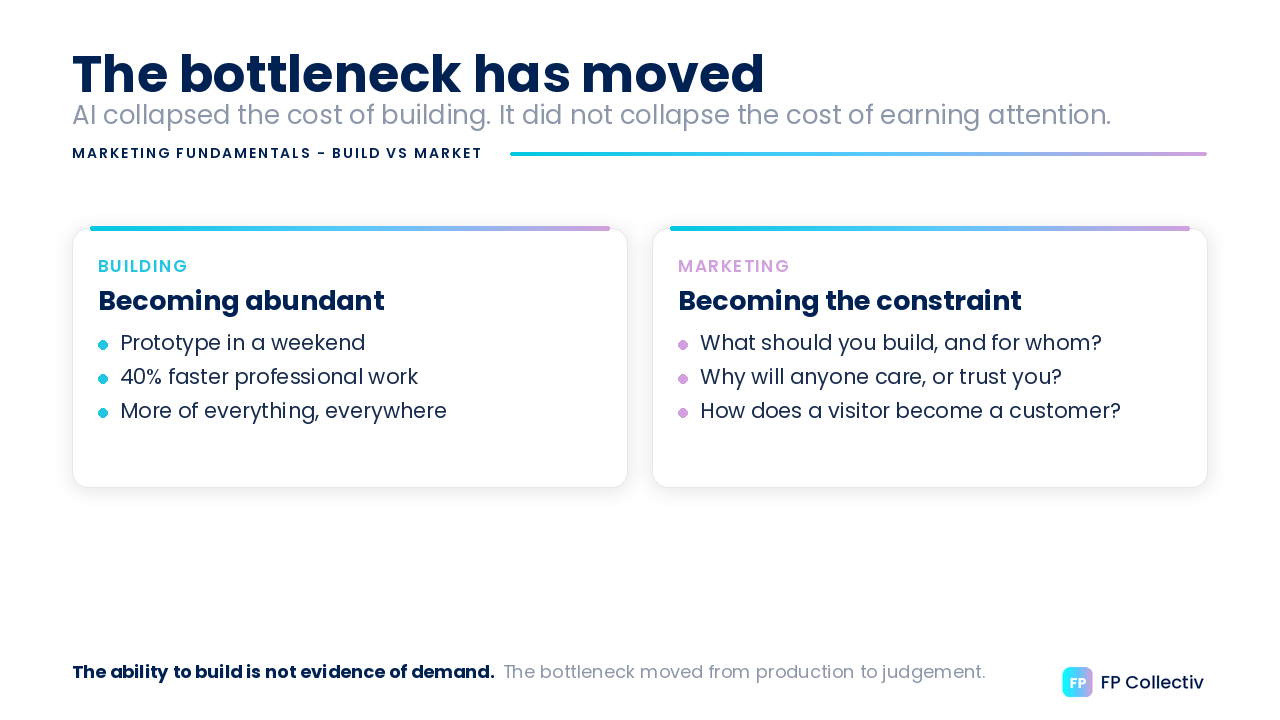
The Bottleneck Has Moved
Much of the conversation about AI ends at the moment of creation. Someone builds an application over a weekend, produces a website in an afternoon or generates a month of content in minutes. The speed is impressive, but the harder commercial questions remain unanswered.
A product can be technically possible without solving an important problem. A website can look credible without giving anyone a reason to visit. A business can publish frequently without developing an audience. An automated email sequence can operate perfectly while promoting an offer nobody particularly wants.
The technology can reduce the effort required to bring an idea into the world. It cannot establish that a sufficient number of people experience the problem, are dissatisfied with the alternatives, are willing to change their behaviour and can be reached economically. Nor can it determine whether the offer is sufficiently distinctive, whether buyers will trust an unfamiliar provider or whether the economics will support growth.
Theodore Levitt warned against this tendency decades ago in Marketing Myopia. His argument was that businesses become vulnerable when they define themselves by the products they make rather than by the customer needs they serve. The danger is even greater when a product can be built before the market has been properly understood.
The ability to build is not evidence of demand.
A founder may be able to launch globally from the first day, but global availability does not produce global awareness. A product may be capable of serving a million customers, but scalability is irrelevant if the first hundred cannot be acquired. The fact that something exists does not mean that people will notice it, understand it, remember it, trust it or choose it.
The bottleneck has moved from producing the product to creating the market conditions in which the product can succeed.
Marketing Was Never Just Promotion
One reason this shift is misunderstood is that marketing has gradually been reduced to a narrow set of visible activities.
In many organisations, marketing has become shorthand for advertising, social media, content, email, campaigns and lead generation. These are legitimate parts of marketing, but they are not the whole discipline.
The American Marketing Association defines marketing as the activities and processes involved in "creating, communicating, delivering, and exchanging" offerings that have value. Communication is part of that definition, but it sits alongside the creation and delivery of value.
The traditional Four Ps make the same point. Product, Price, Place and Promotion describe a much broader commercial remit than communications alone. Promotion is one component of the marketing mix, not the definition of marketing.
Philip Kotler's work helped establish marketing as the process of understanding markets, identifying customer needs, creating value and choosing which customers an organisation is best equipped to serve. Marketing, in this conception, begins well before a campaign is briefed. It influences the product, the market, the customer proposition, the route to market and the commercial model.
This places marketing upstream in the business. It should help determine which problems are worth solving, how a market should be understood, which customers represent the best opportunity and why an organisation has a credible right to win. It should contribute to decisions about the offer itself, the price customers will accept, the way the product is distributed and the position the business can occupy in the customer's mind.
Promotion comes after those decisions. It cannot compensate for their absence.
Yet many marketers are brought into the process only after the product has been developed, the commercial target has been set and the launch date has been agreed. Product teams build, finance sets the price, sales defines the target audience, and marketing is asked to generate demand.
When marketing is confined to the final stage, its role is no longer to help the organisation understand and shape the market. It is to communicate decisions that have already been made.
AI did not cause this narrowing of the discipline. It began much earlier.
Digital marketing played an important part in accelerating it.
How Digital Marketing Changed What We Valued
Digital marketing brought enormous benefits to the profession. It expanded access to customers, made experimentation faster and allowed smaller businesses to reach markets that had previously been inaccessible. It created new forms of customer experience and gave marketers far greater visibility into behaviour and performance.
It also made marketing more accountable. For organisations that had struggled to connect marketing investment with commercial outcomes, this was an important advance.
But every new capability influences what people pay attention to. Digital platforms provided an immediate stream of measurable activity: impressions, clicks, open rates, conversions, leads, cost per acquisition and return on advertising spend. Because these metrics were visible and available quickly, they became easier to report, optimise and defend.
The problem was not measurement. The problem was allowing what could be measured immediately to define the value of marketing.
Les Binet and Peter Field identified this tension in their analysis of the IPA Effectiveness Databank. Their research distinguished between short-term activation, which helps convert existing demand, and long-term brand building, which creates future demand and produces broader commercial effects over time. They also warned that the growing reliance on very short-term online measures could undermine long-term effectiveness.
Digital did not make strategy unnecessary, but it made execution unusually absorbing. There was always another campaign to launch, platform to learn, audience to optimise, dashboard to update or conversion point to improve. Marketing teams increasingly organised themselves around channels and systems, and professional expertise became closely associated with the ability to operate them.
Over time, channel choices began to crowd out customer choices. Optimisation displaced diagnosis. A media plan was described as a marketing strategy, and a collection of platform tactics was mistaken for a coherent approach to growth.
This was not because digital marketing failed. It was because it offered so many useful and measurable things to do.
The urgent gradually displaced the important.
AI Could Repeat the Same Mistake
The early AI conversation follows a familiar pattern. Marketers are being encouraged to identify the best tools, write better prompts, automate more workflows, produce more content and deploy agents to complete increasingly complex tasks.
These are useful capabilities. They can reduce repetitive work, shorten production cycles and make expertise more accessible. But they remain execution capabilities.
They help answer the question, "How can we do this?"
They do not necessarily answer, "Should we do this at all?"
AI can generate hundreds of content ideas without knowing whether the market needs more content. It can create message variations without determining which idea the brand should consistently own. It can summarise customer research without deciding which customers the business should prioritise or which it is willing not to serve. It can produce a campaign without taking responsibility for the commercial reasoning behind it.
The research on the "jagged technological frontier" demonstrates why this distinction matters. In the Boston Consulting Group experiment, AI produced substantial performance gains on tasks that fell within its capabilities. On a task deliberately designed to sit outside that frontier, however, consultants using AI were 19 percentage points less likely to reach the correct answer than those working without it.
The implication is not that AI should be avoided. It is that the technology's value depends on the quality of the task, the context in which it is used and the judgement of the person directing and evaluating the work.
AI can make valuable work faster. It can also make poorly chosen work faster.
If marketing responds to AI by producing more activity without improving the decisions behind it, the profession will repeat the mistake it made during the digital era, only at far greater speed.
A Product Does Not Create Its Own Demand
The belief that a good product will naturally find its market is persistent, particularly among founders and product-led organisations.
Occasionally, it happens. It is not a reliable growth strategy.
Customers do not evaluate every available product and select the objectively superior option. They operate with limited time, incomplete information and varying levels of interest. They rely on memory, familiarity, trust, recommendations and what is easiest to find or justify.
This is especially important in B2B markets, where purchases are often infrequent, involve several stakeholders and carry professional or organisational risk. Most potential buyers are not actively looking for a solution at any particular moment.
Professor John Dawes' 95:5 rule is a useful way of understanding this. The exact ratio differs by category and should be treated as a heuristic rather than a universal constant. The underlying principle is that, for many B2B purchases, the large majority of potential buyers are out of market at any given time. Advertising and other forms of brand building therefore work largely by creating and refreshing memories that can be retrieved when a buyer eventually enters the category.
This has profound implications for a newly created business. Most of its future customers are not currently searching for it. They may already have a supplier, lack budget, be bound by a contract or simply have no immediate need.
Demand-capture activity can help a brand compete for the minority already in the market. Search advertising, comparison content, review platforms and sales outreach can all play an important role at that stage. But they do not explain how the brand entered the buyer's mind before the search began.
Someone has to create the memory. The customer must encounter the brand, understand what it stands for and associate it with a relevant need or buying situation. Familiarity and trust have to be established before the organisation appears on a shortlist.
Research from the Ehrenberg-Bass Institute describes this through mental and physical availability. Brands grow by becoming easier for more category buyers to think of and easier for them to buy. That requires reach beyond the small group already shopping, as well as consistent connections between the brand and the situations that bring people into the market.
This is the work that happens long before a sale is visible in a dashboard. It is also the work that many emerging businesses underestimate because its effects are less immediate than the act of launching a product.
From the First Visitor to a Scalable Business
AI can help a business create its first website, but it cannot guarantee the first visitor. Once that visitor arrives, the challenge becomes understanding what brought them there, whether the offer is relevant and what would persuade them to return.
An audience is not merely accumulated traffic. It is a group of people who recognise value in what a business consistently provides. Developing one requires a clear understanding of the people the organisation wants to serve, the problems it can credibly help solve and the ideas it can contribute better than the alternatives.
Turning that audience into customers requires more than visibility. The offer must be clear, appropriately priced and easy to evaluate. The customer must believe the value outweighs the cost and risk of changing. In B2B markets, the proposition may also need to survive scrutiny from procurement, finance, IT, legal and executive stakeholders.
Scaling introduces another set of questions. The business must determine which acquisition channels are repeatable, whether customer economics are sustainable, whether the brand can extend beyond the founder's personal reputation and whether the proposition remains distinctive as competitors respond.
These are not separate from product development. They are part of building the business.
A technically scalable product with no repeatable route to market is not yet a scalable company. A large potential audience that cannot be reached economically is not yet a viable market. High engagement that does not translate into customer value or revenue is not yet growth.
Marketing connects the idea to the economic reality around it.
When Execution Becomes Abundant, Judgement Becomes Scarce
The falling cost of execution does not make marketing judgement less important. It makes the difference between execution and judgement easier to see.
Execution turns an instruction into an output. Judgement determines whether the instruction is sound.
Judgement is required to distinguish an interesting idea from a commercially valuable one. It is needed to interpret incomplete or contradictory evidence, to understand the trade-offs between short-term revenue and long-term growth, and to choose between several plausible courses of action.
It is also required because marketing decisions are rarely made in a controlled environment. Customers change, competitors react, budgets are constrained and organisations bring their own history, capabilities and politics to the decision. The same evidence can lead to different choices depending on the market, business model and appetite for risk.
AI can contribute to that process. It can retrieve information, challenge assumptions, identify patterns, develop scenarios and improve the speed at which a marketer explores a problem. It may even recommend a course of action.
But the marketer remains responsible for deciding whether the evidence is credible, whether the recommendation fits the context and which consequences the organisation is prepared to accept.
This is why stronger technology increases the need for stronger foundations. The more powerful the tool, the more important it becomes to know what good marketing looks like.
Evidence informs. Judgement decides.
AI Should Give Marketers Time to Become Marketers Again
There is a more constructive opportunity in this shift.
For years, marketers have argued that they do not have enough time for strategic work. Their days are consumed by campaign administration, reporting, presentations, data cleaning, asset production, platform management, stakeholder requests and repetitive coordination.
AI can reduce some of that burden. The evidence from writing, coding and professional knowledge work suggests that well-designed AI assistance can return meaningful time to people while improving performance on suitable tasks.
The important question is what organisations and marketers choose to do with that time.
The easiest response is to demand more output. If a marketer can produce five pieces of content in the time previously required to produce one, the organisation may ask for five. If reporting can be automated, it may request more dashboards. If campaigns can be launched more quickly, it may increase the number of campaigns.
That would capture the productivity gain without necessarily improving marketing.
The greater opportunity is to reinvest the time in work that has been crowded out by execution: talking to customers, studying the category, understanding competitors, improving the offer, clarifying positioning and identifying the real barriers to growth. Marketers could spend more time working with product teams on what should be built, with finance on how value should be priced and with sales on how the market actually buys.
They could make better briefs, ask harder questions and stop activity that does not serve the strategy. They could think more carefully about how brands are built in memory, how future demand is created and how the organisation can become easier to choose.
In that sense, AI should not simply make marketers faster at the version of the job they have inherited.
It should give them the capacity to reclaim the version of marketing the business needs.
Returning to First Principles
Returning to first principles is not an argument for resisting technology or retreating to an earlier era of marketing. Digital platforms, analytics, automation and AI have all expanded what the profession can accomplish. The task is to reconnect those capabilities to the purpose they are meant to serve.
First principles provide a stable foundation when the tools are changing quickly. They require marketers to begin with the market rather than the channel and with the customer rather than the campaign. They ask whether a real need exists, whether the organisation can create meaningful value, whether the offer is distinctive, and whether customers can easily think of it, find it and buy it.
They also give marketers a better way to evaluate new technology. The important question is not simply whether a tool can generate content, automate a workflow or reduce cost. It is whether it helps the organisation understand customers more clearly, make a better decision, create greater value, build stronger memories or improve the customer's ability to buy.
Technology should strengthen marketing capability rather than substitute for marketing thought.
Without first principles, a business can execute efficiently in the wrong direction. With them, AI becomes more useful because it is being applied to better-defined problems, with stronger evidence and clearer standards for evaluating the outcome.
The Return of Marketing
The AI era will create more builders. It will allow individuals and small teams to develop products that would once have required substantial organisations. It will reduce the distance between an idea and its execution and make experimentation cheaper.
This is a meaningful democratisation of capability.
It will not democratise attention in the same way.
Customers will still have limited time and more choices than they can properly evaluate. Businesses will still need to decide which markets to enter and which problems are worth solving. New products will still need to become known, remembered, trusted and easy to buy. Organisations will still need to balance the demand they can capture today with the demand they must create for tomorrow.
Those challenges cannot be solved by production alone.
They require marketers who understand the commercial role of the discipline, who can distinguish activity from progress and who know how to use evidence without surrendering judgement. They require marketing teams that contribute before the product is complete, not simply after the launch date is set.
FP Collectiv exists to help restore that version of marketing.
We believe marketing is a commercial discipline, not a promotional service. It begins with understanding markets and customers, creating value and making choices about where and how a business can grow. Communication matters, but it cannot repair a weak proposition or create lasting demand for something the market does not value.
We believe digital and AI should increase the contribution marketers make to a business. They should reduce lower-value work, improve access to evidence and give marketers more time to think. They should not trap the profession in an ever-accelerating cycle of content, campaigns and optimisation without a clear strategic foundation.
Above all, we believe that first principles become more valuable as the world becomes more complex. Tools will change. Channels will change. The economics of production will change. The need to understand people, create value, build demand and make sound commercial decisions will not.
Everyone can now build.
Few know how to market.
That is the gap FP Collectiv exists to close.
Evidence informs. Judgement decides.
RELATED READING
B2B Marketing Strategy: Build One You Can Defend (On One Page)
What Is Marketing Actually For? A First-Principles Answer for B2B Marketers
AI Is Repricing Marketing Jobs, Not Removing Them: The Evidence
Sources
- American Marketing Association, Definitions of Marketing, on marketing as the creation, communication, delivery and exchange of value.
- Philip Kotler, The Past, Present and Future of Marketing, on the development of marketing and the centrality of customer value.
- Shakked Noy and Whitney Zhang, Experimental Evidence on the Productivity Effects of Generative Artificial Intelligence, Science, 2023.
- Fabrizio Dell'Acqua et al., Navigating the Jagged Technological Frontier, Harvard Business School and Boston Consulting Group field experiment.
- GitHub, Quantifying GitHub Copilot's Impact on Developer Productivity, controlled experiment examining task-completion speed.
- Les Binet and Peter Field, The Long and the Short of It, IPA analysis of short-term activation and long-term brand building.
- Ehrenberg-Bass Institute for Marketing Science, Advertising Effectiveness and the 95:5 Rule, on out-of-market buyers and the role of advertising in building memory.
- Ehrenberg-Bass Institute for Marketing Science, research on how brands grow through mental and physical availability.