
AI Search and B2B Marketing: How Buyers (and AI) Find You Now
Jul 07, 2026
Your next buyer probably will not find you the way your last one did. They will ask an AI assistant to compare the options in your category, read a synthesised answer that names three or four vendors, and form a view of the market before they visit a single website, including yours.
That is not a prediction. In Forrester's Buyers' Journey Survey, reported in January 2026, 94% of business buyers said they used AI in their buying process, and twice as many buyers named generative AI or conversational search as their most meaningful information source than named any other source, far outpacing vendor websites, product experts and sales. G2's 2026 research puts a finer point on it: 51% of B2B software buyers now start their research in an AI chatbot more often than Google, up from 29% in its 2025 survey. In under a year, the front door to most B2B categories moved.
This piece lays out what the evidence actually shows about AI search and B2B marketing, why it makes brand-building more important rather than less, and the five practical moves that determine whether your brand appears in the answers your buyers are now reading. No panic, no hype: the shift is real, and it is navigable if you decide well.
How B2B buying moved, in three numbers
94%
of business buyers use AI in their buying process (Forrester, 2026)
51%
start research in an AI chatbot more often than Google (G2, 2026)
85%
purchase from their day-one vendor list, formed before they search (Bain)
What the Evidence Says About How B2B Buyers Search Now
Three findings, from three different research houses, tell one consistent story.
Buyers research inside AI tools before they ever reach you. Forrester finds buyers using AI across every stage of the buying journey, and buyers themselves report that the tools help them be more productive, consider more vendors in less time and make better decisions for the business. The evaluation that used to happen across your website, your case studies and your sales conversations now largely happens somewhere you cannot see, in a synthesised answer you did not write.
The click economy is shrinking from both ends. Pew Research tracked real Google searches and found that when an AI Overview appears, users click a traditional result 8% of the time versus 15% without one. Gartner's early forecast of a 25% drop in traditional search volume by 2026, widely called aggressive at the time, has largely held direction. Traffic, the metric an entire generation of B2B marketing was built to maximise, is structurally declining as a share of how buyers behave.
And yet the shortlist matters more than ever. Bain's research on zero-click search found that 85% of B2B buyers purchase from their "day one" vendor list: the brands they already had in mind before they searched at all. G2 adds the twist that AI is now actively editing that list: 69% of buyers chose a different vendor than they originally planned based on chatbot guidance, and roughly one in three purchased from a vendor they had never heard of before the chatbot surfaced it.
Put those together and the strategic picture is clear. Fewer buyers are clicking. The ones who decide are deciding from a mental shortlist formed early. And AI answers have become a genuine force in what gets onto that shortlist. The question for your marketing is no longer only "do we rank?" It is "are we present in the answer, and are we remembered before the question is even asked?"
Why This Makes Brand More Important, Not Less
Here is where most of the AI-search commentary gets the conclusion backwards. The reflex is to treat this as a technical problem: new channel, new optimisation acronym, new checklist. The evidence points somewhere more fundamental.
Marketers have known for years, from Ehrenberg-Bass research, that the vast majority of your category is not in market at any given moment: the familiar 95:5 shape of B2B buying. The practical implication was always that marketing has two jobs. Demand creation builds memory in the buyers who are not yet in market, so that your brand comes to mind when they are. Demand capture harvests the intent of the small group buying now.
AI search just raised the stakes on both, in the same direction.
On the creation side: if 85% of buyers purchase from a list formed before they search, and the search itself is increasingly answered by a machine, then being remembered beats being found. The brands that invested in distinctive, consistent demand creation enter the AI era with their names already in buyers' heads, and, it turns out, already in the training data and source material the models draw on.
On the capture side: the buyers who do click through from an AI answer are unusually valuable. They arrive late in their research, having already compared options. Multiple 2026 analyses find AI-referred visitors converting and engaging at meaningfully higher rates than average organic traffic. Fewer clicks, better clicks.
The judgement call this leaves you with: do not respond to AI search by cutting brand investment to fund another tool. The evidence says the opposite. The mental availability you build this year is what the answers, human and machine, retrieve next year.
The Five Moves That Make You Visible to Buyers and AI
Being cited by AI systems is not a trick, and the tricks demonstrably do not work: one 2026 analysis of nearly 1,900 pages that added structured-data markup found no statistically significant citation lift on any platform. What earns citations looks a lot like what earns trust. Five moves, in priority order.
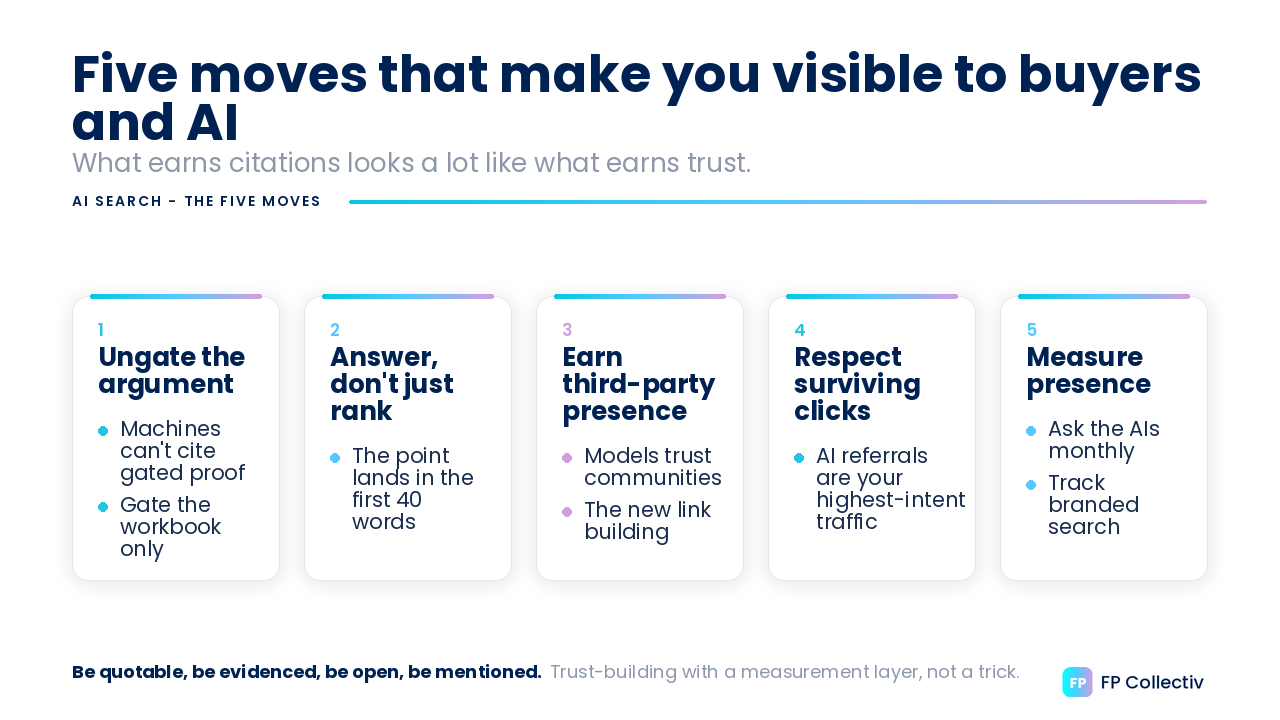
The five moves
Visible to buyers and to AI
1. Publish your best thinking where machines can read it.
Gate the workbook, never the argument.
2. Write content that answers, not content that ranks.
The point lands in the first 40 words.
3. Earn presence in the places models already trust.
Earned presence is the new link building.
4. Keep a human-grade experience for the clicks that survive.
AI-referred visitors are your highest-intent traffic.
5. Measure presence, not just traffic.
Traffic is what happened on your site. Presence is what happened in the market.
1. Publish your best thinking where machines can read it. Bain's zero-click research finds AI summaries are now the default way searches end, with click-through rates in some B2B categories down by as much as 30%. The answers buyers do read are assembled from the open web. Proof that lives behind a gate effectively does not exist to the systems now shaping shortlists. Audit what you have gated: your strongest evidence, your clearest point of view and your definitions should be open. Gate the workbook, not the argument.
2. Write content that answers, not content that ranks. AI systems cite sources that resolve a question cleanly: a clear definition up front, a named statistic, a structured argument, an honest trade-off. The old SEO habit of circling a keyword for 900 words before saying anything is worse than useless here. A useful test for every piece: if a model quoted only your first 40 words, would the reader learn something true and specific?
3. Earn presence in the places models already trust. Pew's analysis of Google's AI summaries found Wikipedia, YouTube and Reddit are the most frequently cited sources, and 2026 citation studies keep reaching the same conclusion: third-party and community mentions matter more to AI visibility than brand-owned pages. For a B2B brand, that means genuine participation where your category is discussed, useful answers under your brand's name, and being worth mentioning by people you do not pay. Earned presence is the new link building.
4. Keep a human-grade brand experience for the clicks that survive. The visitors who arrive from an AI answer are your highest-intent traffic. They have done the comparison; they are validating. A thin landing page squanders them. Make the post-click experience answer the next question in their head: proof, pricing logic, honest fit and non-fit, and a clear next step.
5. Measure presence, not just traffic. If your dashboard only counts sessions, it is structurally blind to the highest-intent moments in your category. Add a presence layer: ask the major AI assistants your buyers' real questions monthly, record whether and how your brand appears, and track branded search and direct traffic as the downstream signal of memory. Traffic tells you what happened on your site. Presence tells you what happened in the market.
None of these five require a new platform or a big budget. They require judgement about what to publish, where to show up and what to measure: which is precisely the work AI cannot do for you.
What This Means for Your 2026 Priorities
If you lead or influence a B2B marketing plan, the evidence supports three reallocations, each with a trade-off worth naming.
Shift weight from rented visibility to owned point of view. Rankings and impressions are becoming intermediated by systems you do not control. A distinctive, evidence-led point of view, published openly, is the asset that both humans and models keep returning to. The trade-off: it is slower to show results than a campaign, and it requires saying something specific enough to disagree with.
Treat community presence as a channel, not a nice-to-have. The citation data is unambiguous about where models look. The trade-off: communities punish promotion and reward genuine usefulness, so this only works if you resource it honestly.
Rebuild measurement before the board asks. Organic traffic declining while revenue holds is now a normal pattern, not a failure, but only if you can show presence and memory moving in the right direction. The trade-off: presence metrics are newer and less standardised, so you will be educating stakeholders as you report.
One more implication, easy to miss. Every move above rewards the same underlying capability: the ability to make sound decisions about what matters, backed by evidence, in a landscape changing faster than any playbook. The marketers who thrive in AI-mediated buying will not be the ones with the longest tool list. They will be the ones whose judgement buyers, and the systems buyers ask, learn to trust. And the same test applies on the other side of the AI decision: for where agents and automation genuinely belong in your marketing, see our evidence review of AI agents in B2B marketing.
Evidence informs. Judgement decides.
RELATED READING
How to Use AI in Marketing: The Strategic Guide (2026)
How to See What Buyers Ask AI About Your Category
Zero-Click Search and AI Answers: What B2B Marketers Need to Do Differently
Ready to Build Marketing That Gets Found and Remembered?
The short version of everything above: AI search has made the fundamentals more valuable, not obsolete. Build memory before the search, be genuinely useful in the answer, and treat the surviving clicks like the high-intent buyers they are.
That sequencing, fundamentals first, then AI as a deliberate layer on top, is exactly how the FP Collectiv curriculum is built: the B2B Marketing track for the fundamentals of creation, capture and measurement, and the Marketing and AI series for using AI to sharpen every one of those decisions, starting with Marketing and AI Foundations.
Sources
Forrester, B2B Buyers Make Zero-Click Number One (January 2026): 94% of business buyers used AI in their buying process (Buyers' Journey Survey); twice as many buyers named generative AI or conversational search as their most meaningful information source than named any other source.
G2, The Answer Economy (April 2026, survey of 1,076 B2B software buyers): 51% now begin research with an AI chatbot more often than Google, up from 29% in the 2025 survey; 69% chose a different vendor than initially planned based on chatbot guidance; 1 in 3 purchased from a vendor they had never previously heard of; AI chatbots now the top source influencing shortlists.
Bain & Company, Losing Control: How Zero-Click Search Affects B2B Marketers (March 2025): 85% of B2B buyers purchase from their day-one vendor list; click-through rates down by as much as 30% in some B2B categories.
Pew Research Center (July 2025, 68,879 tracked searches): click-through falls from 15% to 8% when an AI summary appears; Wikipedia, YouTube and Reddit are the most frequently cited sources in AI summaries.
Gartner press release (February 2024): forecast of a 25% drop in traditional search engine volume by 2026.
Professor John Dawes, Ehrenberg-Bass Institute: the 95:5 rule (see also the Institute's summary): the share of category buyers in market at any time.
Ahrefs (analysis of about 1,900 pages): no statistically significant AI-citation lift from adding JSON-LD structured data.