
AI Agents in B2B Marketing: What the Evidence Says
Jul 07, 2026
Every marketing event, feed and vendor deck right now is promising the same thing: AI agents that will run your campaigns, qualify your leads and rebuild your team around autonomous work. The volume is deafening. The evidence is quieter, and a great deal more useful.
Here is the honest starting point. According to Gartner's 2026 survey, only 17% of organisations have actually deployed AI agents, while more than 60% intend to within two years. Agentic AI sits at what Gartner calls the Peak of Inflated Expectations, and Gartner expects more than 40% of agentic AI projects to be cancelled by the end of 2027. Enormous intent. Thin deployment. A high failure rate already forecast.
That gap is not a reason to ignore agents. It is the reason to be deliberate about them. This piece gives you the evidence base, the distinctions that most coverage skips, and a simple four-question test you can use today to decide where an agent earns its place in your marketing, and where it does not.
The state of play, in three numbers
17%
of organisations have actually deployed AI agents (Gartner, 2026)
60%+
intend to deploy within two years
40%+
of agentic AI projects expected to be cancelled by end of 2027
Where AI Agents Actually Are Right Now
Strip out the hype and the picture is consistent across the major analysts.
On adoption, the story is intent far ahead of reality. Gartner's 2026 survey puts current deployment at 17% of organisations, with the steepest projected adoption curve of any emerging technology it tracks. Most of those deployments are narrowly scoped: agents automating discrete, well-defined tasks rather than running anything end to end. Fully autonomous agents are not ready for most enterprise use cases yet.
On value, the ceiling is real and the results are uneven. McKinsey's landmark analysis puts the annual value potential of generative AI at 2.6 to 4.4 trillion dollars across business use cases. That is the prize everyone is pointing at, and agents are the current wave's claim on it. But the same body of research shows returns that are inconsistent in practice, with a meaningful share of AI initiatives falling short of their expected ROI.
On maturity, the warning signs are already named. Gartner has flagged "agent-washing", the rebranding of ordinary automation and older rule-based tools as AI agents, as an explicit market problem, estimating that only about 130 of the thousands of vendors claiming agentic products are the real thing. The same research predicts that more than 40% of agentic AI projects will be cancelled by the end of 2027, citing escalating costs, unclear business value and inadequate risk controls.
Read those three findings together and a clear judgement emerges. The opportunity is genuine, the technology is early, and most of the failures will come from adopting badly, not from the technology being useless. The winners will not be the marketers who adopt fastest. They will be the ones who decide best.
Agent, Assistant, Automation: The Distinction That Changes Your Decision
Most of the confusion in this conversation comes from one collapsed distinction. People say "agent" to mean three different things, and the differences are exactly what should drive your decision.
An assistant responds to you. You prompt it, it produces something, you review and use it. A large language model drafting a nurture email is an assistant. The human is in the loop on every output, and judgement stays with you at every step.
An agent acts toward a goal across multiple steps, choosing its own actions along the way. Give it an objective ("qualify these inbound leads against our criteria and update the CRM") and it will take a sequence of actions to get there, with far less human intervention per step. The human moves from approving each output to supervising a process.
An agentic system is several specialised agents coordinating under central orchestration. One qualifies, one drafts outreach, one checks compliance, and they hand work to each other. Both Gartner and Forrester point to 2026 as the year multi-agent systems move from concept toward production, though most marketing organisations are nowhere near this yet.
Why does this distinction decide anything? Because your exposure changes completely as you move down the list. With an assistant, a bad output costs you a review cycle. With an agent, a bad decision can propagate through your CRM, your outreach and your reporting before anyone notices. The further you move from assistant toward autonomous system, the more the question shifts from "is the output good?" to "can I see, trust and correct what it is doing?"
Here is what most marketers get wrong: they buy an "agent" that is really an assistant with a confident label, or they hand agent-level autonomy to a task that needed a human in the loop. Naming the three levels honestly is the first act of judgement. It tells you what you are actually deploying, and therefore what could go wrong.
The Four Questions to Ask Before You Give a Task to an Agent
You do not need a governance committee to make a good first call. You need four questions. Run any candidate task through them before you hand it to an agent, and you will avoid the most common and most expensive mistakes.
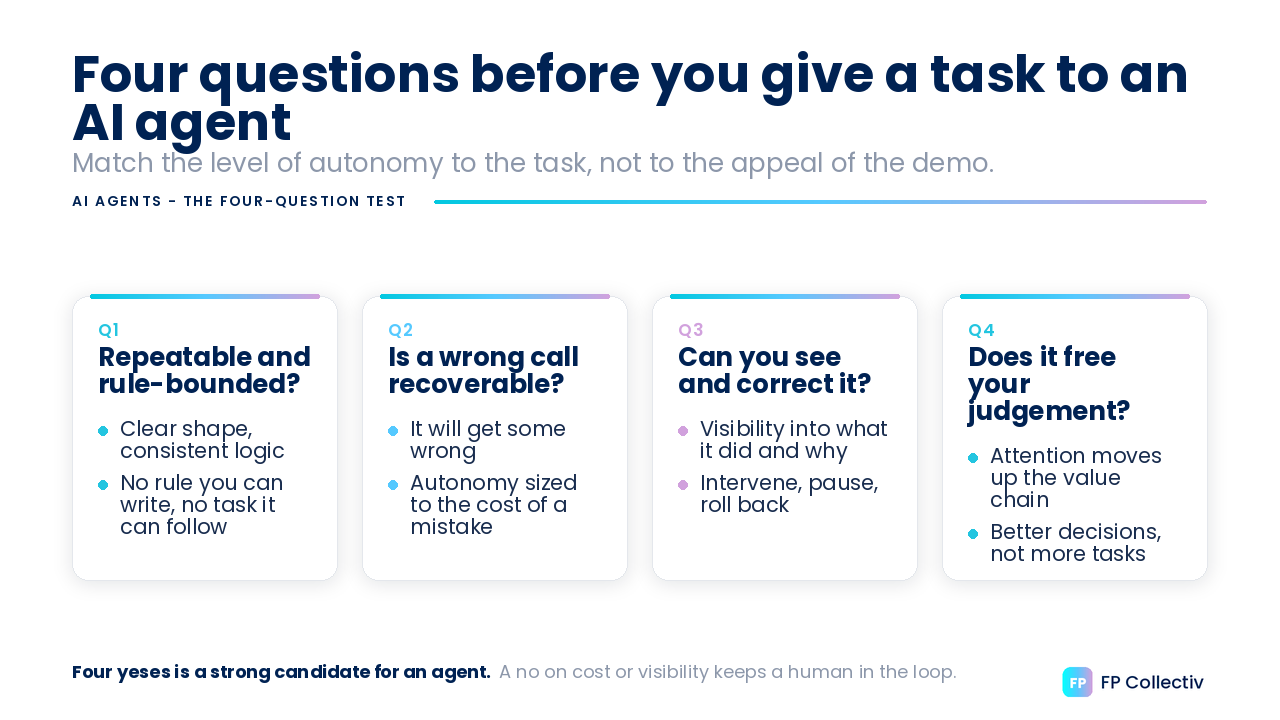
The four-question test
Before you give a task to an agent
1. Is the task repeatable and rule-bounded?
If you cannot write down the rule, the agent cannot reliably follow it.
2. Is the cost of a wrong call low, or recoverable?
Match the level of autonomy to the cost of a mistake, not to the appeal of the demo.
3. Can you see and correct its work?
An agent you cannot observe is a liability, not an asset.
4. Does it free your judgement for higher-value decisions?
The point is not to do more tasks. It is to move your attention up the value chain.
1. Is the task repeatable and rule-bounded? Agents are strong where the task has a clear shape and consistent logic: lead routing, data hygiene, first-pass qualification against fixed criteria, reporting pulls. They are weak where every instance is a judgement call. If you cannot write down the rule, the agent cannot reliably follow it.
2. Is the cost of a wrong call low, or recoverable? Before you automate, ask what happens when it gets one wrong, because it will. A mis-tagged lead is recoverable. An agent sending flawed outreach to your top 50 target accounts, or making a claim that damages the brand, may not be. Match the level of autonomy to the cost of a mistake, not to the appeal of the demo.
3. Can you see and correct its work? You need visibility into what it did and why, and a way to intervene, pause or roll back. Gartner's own guidance on the coming wave of failures points at exactly this: the projects that survive are the ones with monitoring, controls and the ability to correct after deployment, not just build and ship.
4. Does it free your judgement for higher-value decisions? This is the strategic question, and the one that separates using AI well from using it more. If automating a task does not free capacity for better decisions, you are adding complexity for its own sake.
Four yeses is a strong candidate for an agent. A no on question two or three is usually a stop, or at least a "keep a human in the loop". This is not a framework you need to memorise. It is a habit of asking, before the vendor's roadmap decides for you.
Where Agents Earn Their Place in B2B Marketing (and Where They Don't)
The clearest way to see where agents fit is through a distinction that predates AI entirely: the difference between demand creation and demand capture.
Demand capture is the part of marketing that harvests existing intent: routing and qualifying leads, nurturing at scale, keeping the CRM clean, pulling and reconciling reporting, managing the mechanical parts of always-on programmes. This work is often repeatable, rule-bounded and recoverable when it goes wrong. It is where agents earn their place fastest. The evidence agrees: the proven 2026 use cases for agents in sales and marketing cluster around lead generation, pipeline management and personalised outreach at scale, all capture-side work.
Demand creation is the part that builds future demand: the positioning, the message, the creative idea, the point of view that makes a buyer remember you when they eventually enter the market. This is judgement-dense and brand-defining, and it is where autonomous agents are both weakest and riskiest. Not because a model cannot generate a headline, but because the cost of a wrong call is high and the "rule" for what is on-brand and genuinely distinctive cannot be fully written down. This is assistant territory, human firmly in the loop, for good reason.
That split gives you a usable rule of thumb: lean toward agents on the capture and operations side, keep human judgement central on the creation and brand side. It is not absolute, and it will move as the technology matures. But it is a far better starting point than "agent everything", which is how a good share of that projected 40% of cancelled projects will get written.
The deeper point is one the evidence keeps circling. Agents do not remove the need for judgement. They relocate it. The judgement moves from doing the task to deciding which tasks to delegate, how much autonomy to grant, and where the human has to stay. That is a more valuable skill, not a redundant one.
The Skill That Doesn't Get Automated
There is a quieter shift underneath the tool conversation, and it is the one senior marketers should be paying most attention to.
As agents take on more of the executional work, the marketing organisation reorganises around supervising systems rather than performing tasks. Analysts describe flatter, more modular teams and new roles built around orchestrating and overseeing AI rather than manually executing. Increasingly, individuals are measured on how well they use AI, not just on the output they personally produce. This is the "AI marketing organisation of the future" that the industry is starting to plan for.
In that world, the scarce skill is not prompting. It is judgement: knowing what to delegate, what to keep, what "good" looks like, and when the confident output in front of you is quietly wrong. The more the execution is automated, the more valuable the person who can decide well becomes.
There is a second, easily missed implication. As AI search and AI agents increasingly sit between your brand and your buyer, your marketing is no longer talking to humans first. It is talking to models that summarise, filter and recommend. If your proof, your point of view and your best thinking are hidden behind gates or absent from the open web, they effectively do not exist to the systems that now shape buyer shortlists. Building visible, credible, genuinely useful thinking is no longer only a brand exercise. It is how you stay discoverable in an AI-mediated buying journey.
Both of these come back to the same place. Tools change fast. The ability to make sound decisions with them, and to be worth citing when a buyer or a model goes looking, is the durable advantage. Evidence informs. Judgement decides.
RELATED READING
How to Use AI in Marketing: The Strategic Guide (2026)
Humans and AI Agents: Who Does What When They Share the Work
Which Marketing Tasks Should You Automate With AI? (The Four Gates)
Ready to Make Better Decisions About AI Agents?
Here is the whole argument in one line: the marketers who win with AI agents will not be the fastest adopters, they will be the sharpest decision-makers, matching autonomy to the task, keeping judgement where it belongs, and treating agents as a deliberate layer on top of strong fundamentals rather than a shortcut around them.
If that is how you want to approach AI, it is exactly how the FP Collectiv Marketing and AI series is built: fundamentals first, then AI as a sequenced, deliberate skill, starting with Marketing and AI Foundations, never hype and never a replacement for your judgement.
Sources
Gartner, 2026 Hype Cycle for Agentic AI (April 2026): agentic AI at the Peak of Inflated Expectations; 17% of organisations have deployed AI agents while more than 60% expect to within two years (2026 Gartner CIO and Technology Executive Survey), the most aggressive adoption curve among the emerging technologies measured.
Gartner press release (June 2025): more than 40% of agentic AI projects will be cancelled by the end of 2027, citing escalating costs, unclear business value and inadequate risk controls; "agent-washing" named as a market problem, with only about 130 of the thousands of agentic AI vendors estimated to be real.
Gartner, Mainstream Marketing Predicts 2026 (January 2026): by 2028, 60% of brands will use agentic AI to deliver streamlined one-to-one interactions.
McKinsey, The Economic Potential of Generative AI: generative AI could add an estimated 2.6 to 4.4 trillion dollars in value annually across business use cases.
Forrester, The State of Agentic AI, 2026: the maturing of multi-agent systems and near-term agent use cases in sales and marketing.