
Humans and AI Agents: Who Does What When They Share the Work
Jul 07, 2026
The debate about whether to use AI agents is mostly over, and the more useful question has quietly replaced it: once a human and a machine share the same work, who does what?
Get that division of labour right and the evidence says the gains are real. Get it wrong and you land in one of two failure modes: a human doing work the machine should own, or a machine making calls only a human should make. Most teams are currently doing both at once.
This piece lays out what the research actually shows about humans and AI working together, four handover rules for dividing the work, and the skill shift that follows for marketing teams. It builds on our evidence review of AI agents in B2B marketing; that piece covers which tasks to delegate at all, this one covers how to share the work once you have.
The Frontier Is Jagged, and That Changes Everything
The single most useful finding in the human-AI research is also the least intuitive.
In a preregistered field experiment run by Harvard-led researchers with Boston Consulting Group, 758 consultants used AI on realistic professional tasks. On the 18 tasks designed within the AI's capability, performance jumped: consultants using AI completed 12.2% more tasks, finished them 25.1% faster, and delivered significantly higher quality. On a complex task deliberately selected to sit just beyond the AI's competence, the same tools made things worse: consultants using AI were 19% less likely to produce correct solutions than colleagues working without it. They trusted a confident tool across a boundary they could not see.
The researchers called this boundary the jagged frontier. AI capability is not a smooth line where the machine is simply better below some level of difficulty and worse above it. It is jagged: superhuman on one task, unreliable on a neighbouring task that looks almost identical, and the boundary is invisible from the outside.
Sit with the implication for a moment, because it defines the human role. If the frontier were smooth, you could set a policy once ("AI handles everything below this level") and walk away. Because it is jagged, the core human skill is knowing where the frontier runs through your own work, task by task, and re-checking as the tools change. That is not a diminished role. It is the job.
The second finding worth carrying: in a Stanford and MIT study of AI assistance in customer support, productivity rose on average, but the gains were dramatically concentrated among the least experienced workers, who improved several times more than the most experienced. AI compresses the execution gap between novices and veterans. What it does not compress, and arguably widens, is the value of knowing what good looks like: the veterans' remaining advantage was judgement, and it became a larger share of what made them valuable.
Execution is being levelled. Judgement is being repriced upward. Every rule that follows flows from those two facts.
The Four Handover Rules
When a task passes the test for delegation in the first place, these four rules govern how the work is shared. They apply whether the machine in question is an assistant you prompt or an agent running a process.
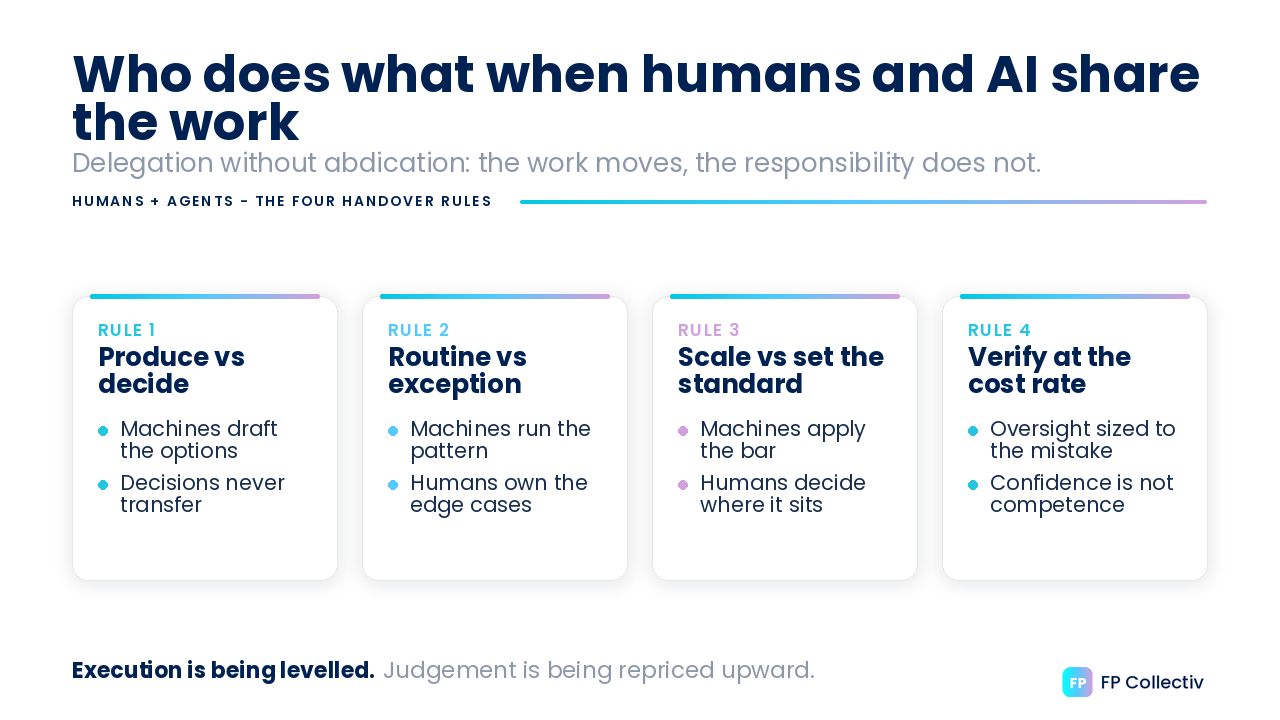
The four handover rules
Who does what when humans and AI share the work
1. The machine produces, the human decides.
Ownership of decisions never transfers, only the labour of producing options.
2. The machine handles the routine case, the human owns the exception.
Escalate, don't improvise. Every escalation is free intelligence.
3. The machine scales the standard, the human sets it.
A thousand instances of the bar; the human decides where it sits.
4. Verify at the rate a mistake costs.
Confidence is not competence, in machines any more than in people.
Rule 1: The machine produces, the human decides. Ownership of decisions never transfers, only the labour of producing options. The machine can draft the nurture sequence, score the leads, assemble the report. The human decides what ships, what a score threshold means, and what the report changes. The moment "the AI recommended it" becomes the justification for a call, the division of labour has silently inverted, and accountability has gone missing with it. A useful discipline: anything that would need your name on it in front of a stakeholder is a decision, and decisions stay human.
Rule 2: The machine handles the routine case, the human owns the exception. Agents earn their keep on the 90% of instances that follow the pattern: the standard lead, the normal data row, the typical routing call. The exceptions are where the value and the risk both live: the strategic account that should never get the standard treatment, the anomaly in the data that is a signal rather than noise, the edge case the rule never anticipated. Design the handover explicitly: define what counts as an exception, make the machine escalate rather than improvise, and treat every escalation as free intelligence about where your rules need work.
Rule 3: The machine scales the standard, the human sets it. An agent can apply a quality bar to a thousand instances, but it cannot know what the bar should be. What counts as a qualified lead, an on-brand sentence, a report worth a leader's time: these standards are judgement calls, and they drift as the market moves. The human job is to set the standard, encode it as precisely as language allows, and revisit it on a schedule rather than assuming last quarter's definition still holds. A practical corollary from the trenches: if you have corrected the same machine output three times, stop and fix the instruction instead. You are doing the machine's learning for it, one review at a time.
Rule 4: Verify at the rate a mistake costs. Oversight is not one setting. A machine tidying data fields can be spot-checked monthly; a machine touching your top accounts gets reviewed per action. The BCG finding is the warning here: the failure mode of human-AI teams is not usually the machine's error, it is the human's calibration, trusting fluent output across an invisible boundary. Match your verification rate to the cost of a wrong call, and increase it whenever the task moves closer to where you suspect the frontier runs. Confidence is not competence, in machines any more than in people.
Four rules, one underlying principle: delegation without abdication. The work moves; the responsibility does not.
What This Does to the Marketing Team
Follow the rules above across a whole function and the shape of the team starts to change, in ways the research is beginning to document.
The obvious shift is that execution capacity stops being the constraint. When drafting, assembling, routing and reporting are largely machine work, a team's output is no longer limited by hands. The new constraints are the human jobs the rules describe: deciding, setting standards, owning exceptions, calibrating trust. Roles built purely on executional throughput are the ones under pressure; roles built on judgement are the ones being repriced.
The less obvious shift is what happens to experience. If novices with AI can execute near a veteran's level, the traditional apprenticeship, where juniors earn judgement by doing years of execution, quietly breaks. Teams will need to teach judgement deliberately instead of letting it accumulate: exposing juniors to decisions and their consequences, reviewing not just what the machine produced but what the human decided about it, and treating "when did you overrule the AI, and why?" as a development conversation. The marketers who grow fastest in the next five years will be the ones whose managers put them in front of decisions early.
And for leaders, one measurement warning carried over from the broader evidence: if individuals are assessed on AI activity, volume of use, output produced, you will get activity. The point of the entire division of labour is that human attention moves to the calls that matter. Measure decision quality and outcomes, or the rules above will lose to the dashboard.
The Skill That Compounds
Here is the thread through everything above. The jagged frontier makes knowing-where-the-line-runs the core skill. The handover rules are that skill written down. The team implications are that skill scaled across a function. In every case, what the human contributes is the same thing: judgement, applied to a machine that has plenty of capability and none of its own.
Tools will keep changing, and the frontier will keep moving. The ability to divide work well, to decide what to delegate, what to keep, what to verify and when to overrule, is the skill that compounds while everything else churns. Evidence informs. Judgement decides.
RELATED READING
How to Use AI in Marketing: The Strategic Guide (2026)
Ready to Build That Skill Deliberately?
That is precisely the capability the FP Collectiv Marketing and AI series is designed to build: fundamentals first, then AI as a sequenced, deliberate layer, starting with Marketing and AI Foundations and running through to working with agents and designing the AI-era team.
Sources
Dell'Acqua, F., McFowland III, E., Mollick, E., et al. (Harvard Business School Working Paper 24-013, with Boston Consulting Group, 2023; forthcoming in Organization Science), "Navigating the Jagged Technological Frontier": preregistered field experiment with 758 consultants; on 18 tasks within AI capability, AI users completed 12.2% more tasks, 25.1% faster, at significantly higher quality; on a task selected beyond the frontier, AI users were 19% less likely to produce correct solutions.
Brynjolfsson, E., Li, D., and Raymond, L. (NBER Working Paper 31161, 2023), "Generative AI at Work": AI assistance in customer support raised productivity on average, with the largest gains concentrated among the least experienced workers.
Gartner (2026 Hype Cycle for Agentic AI; June 2025 press release): adoption, cancellation and agent-washing context as covered in the companion pillar.