
What Is Marketing Actually For? A First-Principles Answer for B2B Marketers
Jun 21, 2026
Most marketers can't answer this question in one sentence. Ask a room full of B2B marketers what marketing is actually for, and you'll get a dozen different answers: brand awareness, lead generation, demand creation, pipeline, content. All of these are activities. None of them are the purpose.
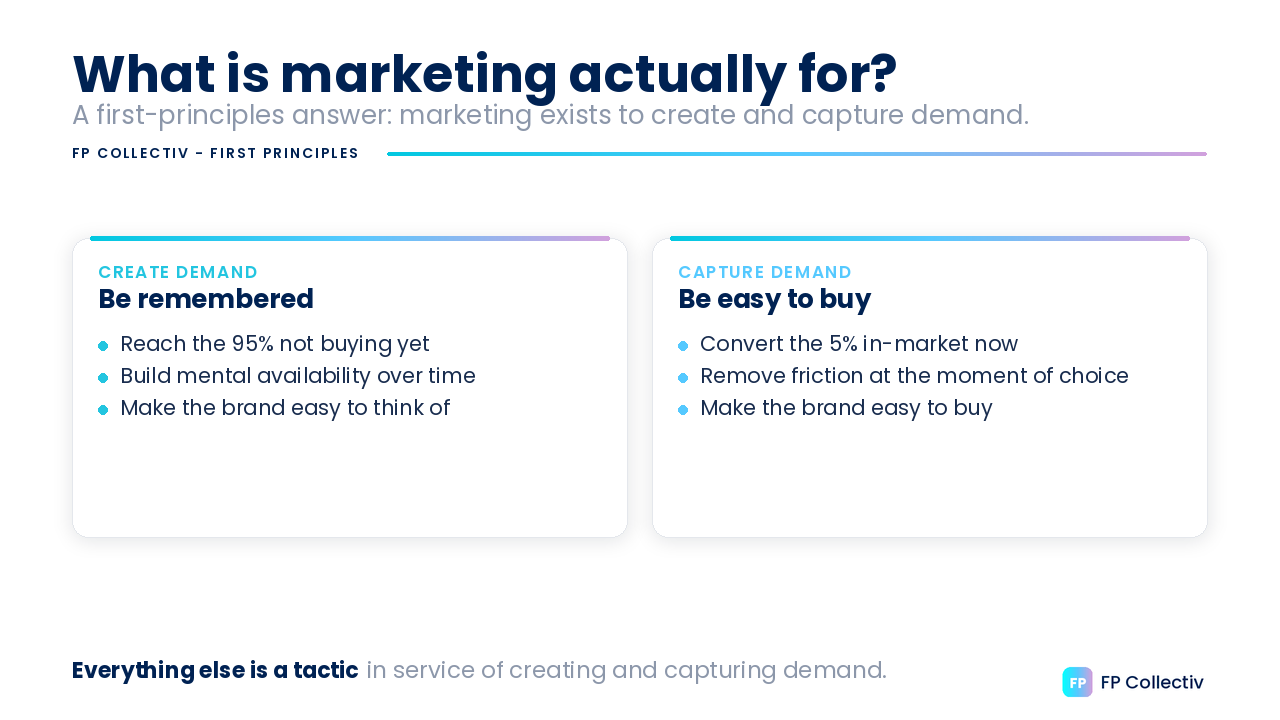
Here is the direct answer: marketing exists to build and maintain mental availability and physical availability for a brand, so that when a buyer enters the market, your brand is the one they think of and the one they can easily buy. That definition comes from the Ehrenberg-Bass Institute for Marketing Science, and it is the closest thing the discipline has to a settled, evidence-based answer.
Why this gets confused
Most marketers never received formal training in what marketing actually does. They inherit a job title, a set of channels, and a quarterly target, and they back into a definition of marketing from whatever their function happens to measure. A demand gen marketer defines marketing as pipeline. A brand marketer defines it as awareness. A content marketer defines it as engagement. Each is describing their slice of the job, not the job itself.
The research, plainly stated
THE KEY RESEARCH
What the evidence actually says about how brands grow
1. Brands grow by reaching new buyers, not deepening loyalty
Sharp's Ehrenberg-Bass research across categories and countries shows brands grow primarily by acquiring new, light, often indifferent buyers, not by making existing customers buy more. Buyers are mostly out of market most of the time.
2. Brand-building and activation do different jobs on different timelines
Binet and Field's analysis of hundreds of IPA effectiveness studies shows both are necessary: brand activity reaches the 95% not yet in market; activation converts the 5% who are. Each has different payback periods.
3. Most B2B budgets are built entirely for the wrong group
Most B2B marketing budgets skew almost entirely toward activation, chasing the small in-market group with demand gen tactics, while doing almost nothing to build availability with the 95% not yet buying.
What this means for how you spend your time
If marketing's purpose is mental and physical availability, then the test for any marketing activity is simple: does this make us easier to think of, or easier to buy, for more potential buyers? A webinar that only reaches people already evaluating vendors fails that test for most of its theoretical audience. A piece of content that builds a distinctive, recognisable point of view, seen by people who are not yet buying anything, passes it.
This is not an argument against lead generation. It is an argument for sequencing: build availability broadly and consistently, and the in-market minority converts at a far higher rate when they do arrive, because they already know who you are.
Where to go next
This first-principles view, why brands grow, what mental and physical availability mean in practice, and how to apply it to a B2B marketing plan, is the foundation of Module 1 of B2B Marketing Fundamentals. It's free, and it walks through the evidence in more depth than a single post can. To see how this purpose turns into a plan, read B2B Marketing Strategy: Build One You Can Defend (On One Page).
RELATED READING
B2B Marketing Strategy: Build One You Can Defend (On One Page)
Sources
Sharp, B. (2010), "How Brands Grow", Ehrenberg-Bass Institute for Marketing Science: Evidence-based research showing that brands grow primarily through mental and physical availability, not loyalty programmes or customer relationship depth.
Binet, L. and Field, P. (IPA), "The Long and the Short of It": Analysis of hundreds of IPA Effectiveness Award cases, establishing the evidence base for brand-building investment ratios and long-term revenue growth.