
How to Defend Your Marketing Budget to the CFO (With Evidence)
Jun 21, 2026
Every downturn, every flat quarter, every new CFO, and marketing's budget ends up on the table. Not because marketing doesn't work, but because most marketers can't explain why it works in language Finance trusts: cash flow, payback period, and risk.
This isn't a pitch deck problem. It's an evidence problem. If you don't understand how marketing actually drives growth, you can't defend it under pressure, you can only assert it.
Why marketing gets cut first
Finance teams cut what they can't model. Marketing is usually presented as a cost center with a vague upside: brand awareness, engagement, "pipeline influenced." None of that survives a budget review with a CFO holding a spreadsheet.
Sales has a number. Product has a roadmap. Marketing, too often, has a vibe.
The fix isn't better slides. It's a different starting model, one grounded in how buying actually happens, not how marketing wishes it happened.
Two numbers that change the conversation
The first is the 95-5 rule, from B2B research by LinkedIn's B2B Institute and Verb, building on work by the Ehrenberg-Bass Institute: at any given time, roughly 95% of your total addressable market is not in-market to buy. They're not ignoring you. They're not ready. The other 5% are actively looking right now.
Most marketing budgets are built entirely for the 5%, demand capture, bottom-of-funnel, last-touch attribution. It looks efficient because it's measurable. But it quietly starves the 95%, which is where next quarter's and next year's buyers currently live.
The second number is the 60-40 split that Les Binet and Peter Field's long-run effectiveness research keeps surfacing: brand-building activity reliably outperforms short-term activation on long-term profit growth, even though activation wins every short-term efficiency metric. Roughly 60% of budget toward brand, 40% toward activation, is the balance their data supports across categories, B2B included.
Put together, these two findings explain the trap most marketing budgets fall into: spend that's easy to justify quarter to quarter and that quietly erodes the pipeline two years out.
How to make the case
THREE MOVES
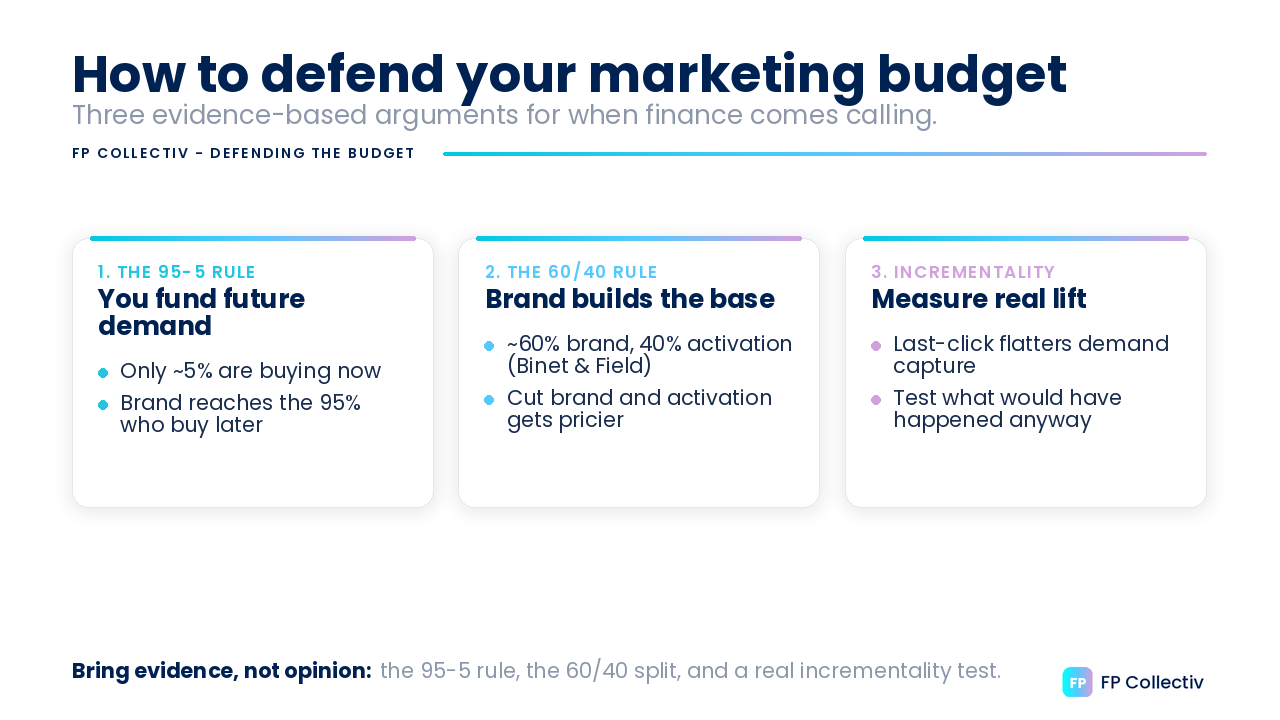
How to make the case when Finance comes calling
1. Reframe the time horizon
Ask what decision is actually being made: this quarter's spend, or next 12 to 24 months of pipeline? Binet and Field's data shows brand cuts surface as revenue damage long after the decision is forgotten.
2. Separate the budget by job
Show what funds demand capture (the 5% in-market) vs. demand creation (the 95% not yet buying). A cut framed in those terms gets scrutinised very differently than an undifferentiated line item.
3. Bring evidence, not opinion
Cite Ehrenberg-Bass on market penetration and Binet/Field on the 60:40 balance, not your own campaign metrics. Finance teams trust patterns observed across hundreds of categories.
The deeper point
None of this guarantees your budget survives every review. But it changes what's being argued about. Instead of defending marketing's existence, you're discussing allocation between two well-evidenced jobs marketing has to do, and that's a conversation Finance can actually engage with.
RELATED READING
How to Set a B2B Marketing Budget (Benchmarks and Allocation)
What Is the 95:5 Rule in B2B Marketing?
What the Board Expects From B2B Marketing (and How to Present It)
Sources
LinkedIn B2B Institute, "The 95-5 Rule": Research showing that approximately 95% of B2B buyers are not actively in-market at any given time, meaning most marketing spend reaches people who won't buy for months or years.
Binet, L. and Field, P. (IPA), "The Long and the Short of It": Effectiveness data showing an optimal budget split of approximately 60% brand-building to 40% activation for sustained B2B revenue growth.