
Building an AI-Ready Marketing Team: Skills, Gaps, and How to Close Them
Jul 10, 2026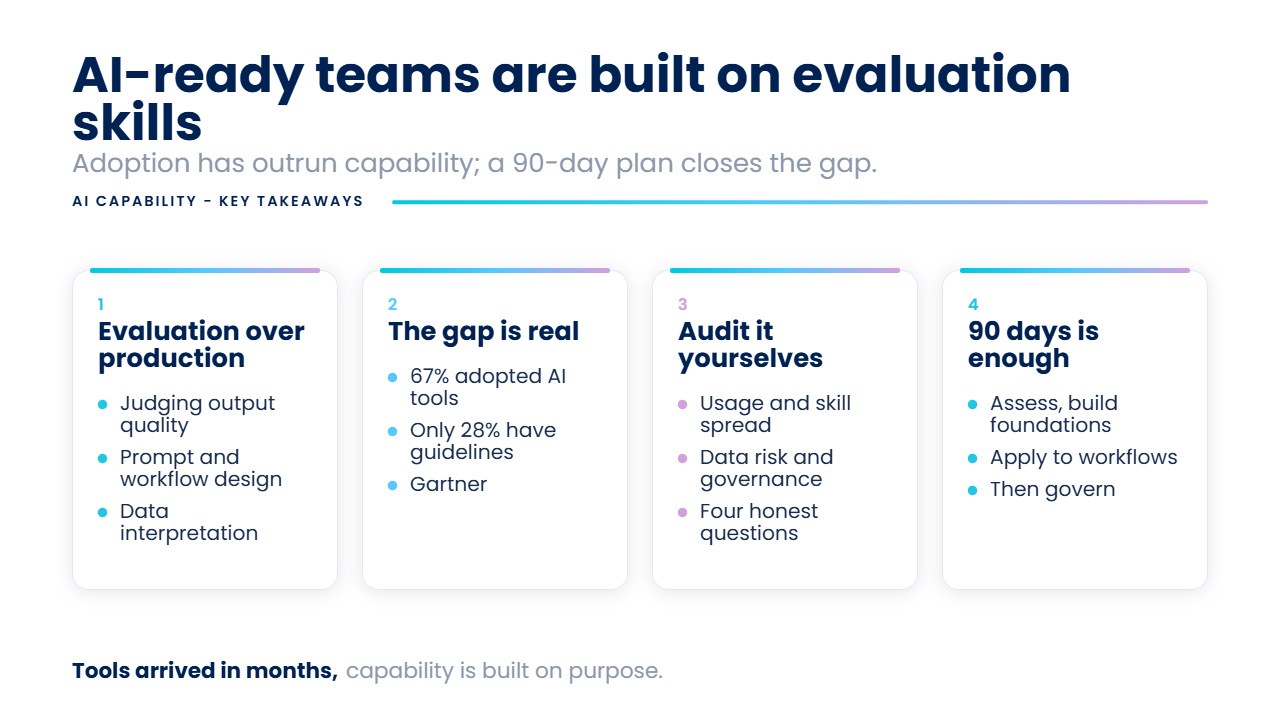
Most B2B marketing teams have adopted AI tools. Far fewer have built the skills to use them well.
The capability gap isn't about access to technology. It's about evaluation, governance and workflow design: the ability to assess whether AI output is good, to build processes that use AI reliably, and to maintain oversight when things go wrong. McKinsey's 2024 State of AI report found that while tool adoption has accelerated rapidly, organisational capability to capture value from AI lags significantly behind, and that gap tends to widen as AI usage increases without matching investment in skills.
This post covers which skills matter most now that AI handles production tasks, where the gaps typically sit in marketing teams, how to assess your own team's AI readiness, and a 90-day plan to build genuine capability across the function.
The Skills That Matter More Now That AI Handles Production Tasks
When AI can produce a first draft, generate image concepts, summarise research, and build campaign reports in seconds, the skills that create competitive advantage shift. They don't disappear, but they change shape.
Four skills matter most right now.
Critical evaluation of AI output. AI produces confident-sounding content that can be factually wrong, subtly off-brand, or strategically misaligned. The marketer who can't evaluate AI output quickly is more exposed than the one who doesn't use AI at all. This means being able to read a draft and ask: is this accurate, is this on-strategy, and is this something I'd stand behind professionally?
Prompt design. Vague input produces vague output. The ability to frame a task clearly, specify constraints, provide context, and iterate toward a useful result is a skill that compounds significantly. Teams that invest in prompt literacy consistently produce better AI output than teams that don't, regardless of which tools they're using.
Workflow architecture. AI tools don't come with instructions for how they slot into a marketing function. Someone on the team needs to design where AI fits, what it handles, what it doesn't, and how quality is maintained across the whole workflow. This is closer to operations design than creative skill, and it's undervalued in most teams.
Data interpretation. AI measurement and analytics tools produce a lot of numbers. The ability to evaluate whether those numbers mean what they appear to mean, whether the model is capturing the right signals, and whether the recommendation is commercially sound requires a marketer who understands both the data and the business context behind it.
These are judgement skills. They're what remain irreplaceable regardless of how capable AI tools become.
The Capability Gaps Most Marketing Teams Have Right Now
Gartner's 2025 marketing technology survey found that 67% of marketing teams had adopted AI tools in at least some capacity, but only 28% had governance guidelines in place for AI use. That's the gap in practice: adoption running well ahead of capability and oversight.
The specific gaps tend to cluster in three areas.
Evaluation skills. Teams know how to prompt an AI tool into producing output. Fewer know how to assess whether that output is accurate, appropriate, and aligned with brand and strategy. This matters because AI errors that go uncaught compound: a flawed insight cited in a brief becomes a flawed strategy backed by "data".
Governance and risk awareness. Most marketers using AI tools haven't considered what data is appropriate to enter into AI systems, what disclosure is required for AI-generated content, or what the liability position is if AI output is wrong or misleading. These aren't exotic concerns. They're live risks in any organisation using AI at scale.
Workflow consistency. When AI adoption is individual rather than systemic, you get wildly uneven capability within a single team. One person uses AI to cut hours off content production. Another doesn't use it at all. A third uses it but shares sensitive data without realising the risk. Unmanaged AI adoption creates inconsistency and exposure simultaneously.
The common thread: tool access was prioritised over skill development. That's understandable in a fast-moving environment, but it's the part that needs to catch up now.
How to Audit Your Team's AI Readiness Without a Consultant
An AI readiness audit doesn't require external help. It requires honest answers to four questions.
What are people actually using AI for? Survey the team informally. Ask what tasks they're using AI tools for, which tools they're using, how often, and what results they're getting. You'll quickly see where usage is high, where it's uneven, and where it's absent. Map this against where AI would theoretically have the highest impact on the function's output.
What's the skill distribution? Identify who on the team can evaluate AI output critically, who understands the data well enough to assess AI analytics output, and who has built repeatable AI workflows. Don't assume seniority maps onto AI capability. Often it doesn't.
Where is the risk exposure? Ask specifically about data practices: are people entering client data, proprietary campaign data, or personal information into AI tools? Do they know the data handling policies of the tools they're using? This single question often surfaces the most significant governance gap.
What's missing from governance? Does your team have documented guidelines for AI use? Do people know what's in scope and out of scope? Is there a process for reviewing AI-generated content before it goes out? The absence of any of these is a gap that needs closing.
The audit output is a simple gap map: highest-impact skills, current coverage, priority order for addressing them. It doesn't need to be a formal document. It needs to be honest.
A 90-Day Plan for Building Genuine AI Capability Across the Function
Ninety days is enough time to make meaningful progress on AI capability if the effort is focused. Here's how the four phases break down.
Days 1 to 21: Assessment and baseline. Complete the readiness audit. Document where the team is, where the gaps are, and what the highest-priority capabilities to build are. Set a baseline by identifying one or two measures that will tell you whether the capability has genuinely improved: output quality, time on task, governance incident rate, or similar.
Days 22 to 45: Foundation skills. Address the most critical gaps first. Critical evaluation and prompt design are typically the highest-leverage foundations. Run short, applied sessions, not theoretical training. Have people work through real tasks from their actual roles using AI tools, then evaluate the output together. Practice matters more than curriculum.
Days 46 to 70: Applied workflow. Take the skills from the foundation phase and build them into actual workflows. Identify two or three processes where AI can meaningfully improve output or efficiency, design the workflow, document it, and get the relevant people using it consistently. This is where individual skill becomes team capability.
Days 71 to 90: Governance and consolidation. Put governance in place: data handling guidelines, output review processes, disclosure standards for AI-generated content. Document the workflows you've built. Review the baseline measures you set in week one. Identify what to tackle next.
This isn't a one-time programme. AI capability needs ongoing investment as the tools develop. But the first 90 days should produce a team that uses AI more confidently, more consistently, and more safely than it did before.
KEY TAKEAWAYS
Building an AI-Ready Marketing Team: Skills, Gaps, and How to Close Them
1. The skills that matter most are evaluation, not production
Critical evaluation of AI output, prompt design, workflow architecture and data interpretation are the capabilities that create competitive advantage now.
2. Adoption has outrun capability in most teams
Gartner found 67% of teams have adopted AI tools but only 28% have governance guidelines. The gap is in evaluation and oversight, not tool access.
3. You can audit your team's AI readiness without a consultant
Four honest questions about usage, skill distribution, data risk and governance will surface the gaps that matter most.
4. A 90-day plan is enough to build genuine, team-wide capability
Assessment, foundation skills, applied workflows, governance: four phases that move AI from individual experimentation to consistent team practice.
Ready to Build an AI-Capable Marketing Team?
The Marketing and AI track at FP Collectiv covers the evaluation, prompting and workflow skills that separate teams using AI well from those using it at all. It's practical, evidence-led, and designed for B2B marketing teams who need to build real capability, not just tool familiarity.
Every module translates directly into how you work, with frameworks and practice built around the decisions B2B marketing teams actually face.
Sources
McKinsey & Company, "The State of AI in 2024," McKinsey Global Survey, 2024.
Gartner, "Marketing Technology Survey," 2025.
Note: Aggregator-sourced figures should be traced to primary sources before publication.
THE BRIEFING
Evidence-led marketing, delivered fortnightly.
Join B2B marketers who want sharper decisions, not more noise.
Join the Briefing