
How to Build a Marketing AI Governance Policy That Actually Gets Used
Jul 10, 2026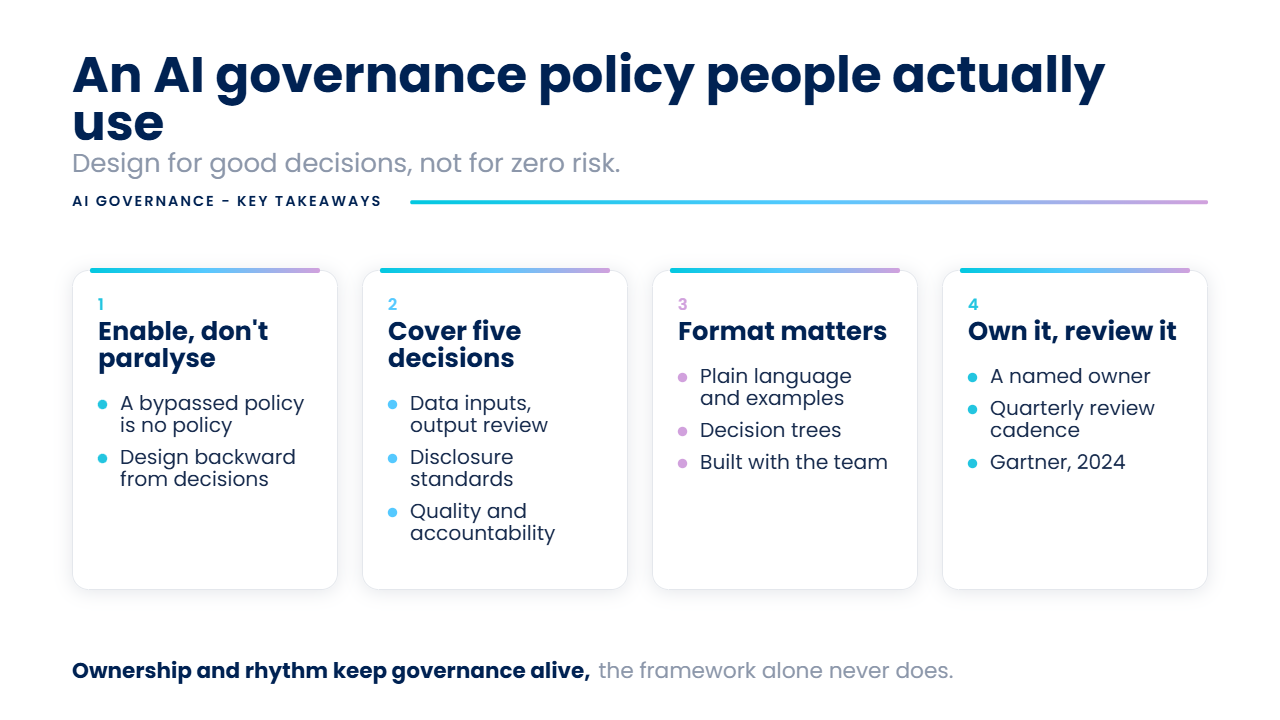
Most AI governance policies fail for the same reason most compliance documents fail: they're written by people who aren't doing the work, for people who don't have time to read them.
An effective AI governance marketing policy for a marketing team isn't a legal document. It's a decision-making aid that helps people use AI tools confidently, consistently, and safely without needing to escalate every judgement call. The goal is enabling good decisions at speed, not preventing all possible misuse.
This guide covers why most AI policies don't work, the five decisions every marketing team needs policy to cover, how to write guidelines teams will actually follow, and how to keep the framework current as AI capabilities develop.
Why Most AI Policies Fail (and What "Governance" Should Actually Achieve)
The most common failure mode is the policy that arrives from Legal or IT, runs to twelve pages of risk language, and gets filed without being read. The second most common is the policy written for an AI landscape that was accurate six months ago and is already out of date.
Effective governance isn't about covering every possible misuse scenario. It's about enabling the team to make the right decision in the moment, without needing to ask upward every time. A governance framework that creates paralysis is as harmful as one that doesn't exist at all, because it either slows everything down or gets bypassed entirely.
The test for whether a governance policy is working: do the people who need to follow it know what to do in the specific situations they face daily? Not in theory. In practice. When a copywriter wonders whether it's acceptable to paste a client brief into an AI tool, the policy should answer that question in under 30 seconds.
This means governance has to be designed backward from the decisions the team actually faces, not forward from the risks Legal wants to cover. Both matter, but the order matters too.
The Five Decisions Every Marketing Team Needs Policy to Cover
Good AI governance for a marketing team is built around five specific decision categories. Everything else follows from these.
1. What data can go into AI tools? This is the highest-stakes question and the one most teams get wrong by default, either through over-restriction (blocking useful use cases) or under-restriction (putting client data, financial data, or personal information into tools without understanding the privacy implications). The policy needs to say clearly: what categories of data are in scope, what are out of scope, and why.
2. What outputs require human review before use? Not all AI output carries the same risk. A draft headline for internal review needs less oversight than a piece of thought leadership going to 10,000 subscribers. The policy should specify which output types require review, by whom, and at what stage in the workflow.
3. What disclosures are required for AI-generated content? This is an evolving area. Some jurisdictions are introducing disclosure requirements. Some publishing platforms have their own rules. Some brand guidelines require disclosure. The policy needs to state the team's current position with the expectation that this section will need updating as the external environment develops.
4. How is quality maintained? AI can produce a lot of content quickly. That doesn't mean the content is good. The policy should address who is responsible for quality evaluation, what standards apply (brand voice, factual accuracy, strategic alignment), and what the process is when quality standards aren't met.
5. Who is accountable when things go wrong? When an AI tool produces content that turns out to be factually wrong, includes a confidential client detail, or misrepresents the brand, someone is accountable for fixing it. The policy should establish clear accountability in advance, not as an afterthought when something has already gone wrong.
How to Write Guidelines Teams Will Actually Follow
The format of governance guidelines matters as much as the content. A twelve-page policy document is not a governance tool. It's a risk-management artefact that satisfies Legal and sits unread in a shared drive.
Guidelines teams actually follow have four characteristics.
Plain language. Write as if explaining to a new team member on their second day. No legal qualifications or hedged language. State the decision clearly. If there's an exception, state that clearly too.
Decision-tree format for common scenarios. Instead of principles that require interpretation, give people a path through the decision. "If you're using client data: is it anonymised? Yes, proceed. No, do not enter it and refer to [person]." This makes the right decision obvious in the moment, rather than requiring the team member to translate a principle into a specific action.
Example-based, not rule-based. Concrete examples of what's acceptable and what's not are more useful than abstract rules. "Using AI to draft initial copy for your own team's content: acceptable. Pasting a client's confidential brief to generate copy for their campaign: not acceptable." People remember examples. They forget principles.
Built with the team, not handed down to them. The governance framework will get more buy-in and more accurate use if the people who need to follow it were involved in building it. Run a working session with the team where you work through the five decision categories together. The act of discussing the decisions builds shared understanding. The document that comes out of it will reflect what the team actually faces, not a theoretical risk model.
Keeping Your Governance Framework Current as AI Capabilities Change
An AI governance policy written today will be materially incomplete within six to twelve months. The capabilities are developing too quickly for any static document to stay current without active maintenance.
The mechanism that works is a quarterly review cadence with a named owner. The review covers three questions: have the AI tools we're using changed in ways that affect our guidance? Have any external requirements changed, regulatory, platform, or contractual? Have we encountered any situations our current guidance didn't cover well?
The quarterly review should be a short working session, not a formal audit. Ninety minutes, the same owner each time, with input from the team on situations they've encountered that weren't well covered by current guidance. The output is an updated guidance document and a brief communication to the team on what changed and why.
The named owner matters. Governance frameworks without a specific accountable person don't get updated. The owner should be the most senior marketing leader in the team, not delegated to an ops or compliance function. AI capability decisions are marketing strategy decisions and they need ownership at that level.
Communication of changes is as important as making them. When the guidance updates, tell the team what changed, in plain language, with examples. A version-noted document in a shared drive doesn't constitute communication, and guidance that isn't communicated doesn't change behaviour.
Gartner's 2024 research on AI governance in enterprise organisations found that the teams with the highest AI maturity scores were significantly more likely to have a named governance owner and a documented review cadence than those with lower scores. The framework itself mattered less than the ownership and the rhythm of keeping it current.
KEY TAKEAWAYS
How to Build a Marketing AI Governance Policy That Actually Gets Used
1. Governance is about enabling good decisions, not preventing all risk
A policy that creates paralysis or gets bypassed is as harmful as no policy. Design backward from the decisions your team actually faces daily.
2. Five decisions every marketing team needs policy to cover
Data inputs, output review requirements, disclosure standards, quality maintenance, and accountability when things go wrong. Everything else follows from these five.
3. Plain language, decision trees, and examples beat principles and rules
The format matters as much as the content. Guidelines built with the team and expressed in examples get followed. Twelve-page legal documents don't.
4. A named owner and quarterly review cadence is what keeps governance working
Gartner's 2024 research found that ownership and review rhythm, not the framework itself, are what separates high-maturity teams from low-maturity ones.
Ready to Build AI Governance That Actually Works?
The Marketing and AI track at FP Collectiv includes a full module on AI governance: how to run the team workshop, how to write the guidelines, and how to build the review cadence that keeps the framework current. It's designed for marketing leaders who need to move from ad hoc AI use to a consistent, governed practice.
Evidence-led. Practically structured. Built for the decisions you're actually making.
Sources
Gartner, "AI Governance in Enterprise Organisations," 2024.
Forrester Research, "AI Risk and Governance Survey," 2024.
Note: Aggregator-sourced figures should be traced to primary sources before publication.
THE BRIEFING
Evidence-led marketing, delivered fortnightly.
Join B2B marketers who want sharper decisions, not more noise.
Join the Briefing