
AI Agents in Marketing: What They Can Do Now, What They Can't, and What's Next
Jul 10, 2026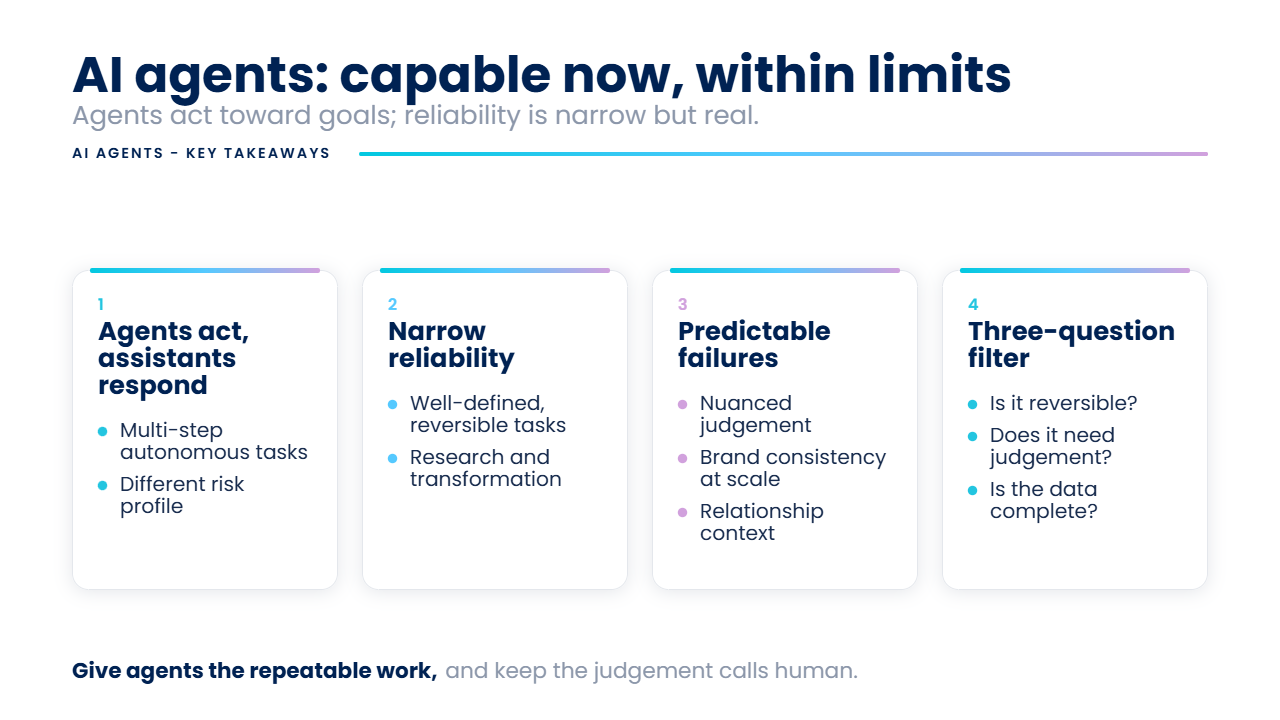
Most AI tools generate text when you prompt them. AI agents do something categorically different: they take sequences of actions, make intermediate decisions, and complete multi-step tasks without human involvement at every step. That distinction matters more than almost anything else in how you deploy AI across a marketing function.
The gap between what vendors describe and what agents reliably deliver is still wide. Decision-makers who close that gap early will build more useful AI programs than those who buy the pitch.
What an AI Agent Actually Is (Defined Without the Hype)
The term "agent" is overused in marketing technology right now, which creates confusion about what you're actually buying or building. A useful working definition: an AI agent is a system that can perceive its environment, make decisions, take actions, and observe the results of those actions in a loop. It doesn't just respond to a prompt. It plans and acts.
Where a standard AI assistant gives you an answer when you ask a question, an agent can be given a goal and pursue it through multiple steps. You might set a task: "Monitor competitor job postings weekly, summarise hiring signals by function, and flag anything suggesting a major go-to-market shift." A capable agent handles that sequence, querying data sources, synthesising findings, and routing output as needed, without you re-prompting at each step.
The distinction between assistant and agent is about autonomy over time. Assistants respond; agents act. This matters because it changes both the value and the risk profile of deployment.
What Agents Can Do in Marketing Today with Reliability
The reliable applications are more modest than vendor marketing suggests, but they are genuinely useful. McKinsey's 2024 research on AI in marketing identified four categories where AI automation performs consistently: synthesis of existing documents, classification and routing of inbound content, first-draft generation for well-defined formats, and scheduling and prioritisation based on defined rules.
In practice, this translates to research aggregation (an agent that monitors industry publications and delivers a weekly briefing), content triage (routing inbound lead responses based on signals in the message), and repetitive structured tasks like reformatting content for different channels or updating records from form completions.
These applications work because the tasks are well-defined, the failure mode is low-stakes and reversible, and the data the agent needs is accessible and reliable. When those three conditions are met, agents deliver genuine efficiency. When any one is missing, reliability drops sharply.
Workflow routing and scheduling are another area where agents perform well. Assigning a task to the right person based on defined criteria, sending a follow-up when a trigger fires, moving a record through a pipeline stage: these are structured and rule-based, which is exactly where agents excel.
Where Agents Still Fail and Why That Matters for Your Workflow
The failures cluster around four problem types. Understanding them is more useful than treating agent limitations as a temporary technical gap to be solved by a future model update. Some of these limitations are structural.
Nuanced judgement. Tasks that require assessment of creative quality, strategic fit, or audience resonance are not well-suited to current agents. An agent can generate ten ad variants; it cannot reliably tell you which will resonate with a specific buyer segment in a specific market context. Gartner's 2024 analysis of enterprise AI programs found that the most common deployment failure was assigning agents to tasks that required domain judgement the system didn't have access to.
Brand consistency at scale. AI agents working at volume drift from brand standards. Gartner noted that organisations running high-volume AI content generation without structured human review saw measurable brand consistency degradation within 90 days. The agent doesn't know what makes your brand voice distinct; it knows patterns from its training data, and those patterns shift when context changes.
Relationship context. B2B marketing operates inside relationships with political dynamics, history, and interpersonal nuance that agents have no access to. Automating client-facing communication without human oversight is the highest-risk application, not because agents write badly but because they lack context about the relationship.
Real-time data. Most agents work from training data or from sources you explicitly connect. If your competitive landscape shifts in a way not captured in those sources, or if a market event happens between data refreshes, the agent won't know. Decisions informed by stale data are a consistent failure mode in agent deployments.
How to Decide Which Tasks to Give to an Agent and Which to Keep
A three-question framework handles most task allocation decisions without requiring a full technical assessment for every candidate task.
Is this task reversible quickly if the agent gets it wrong? Agents should own tasks where a mistake can be caught and corrected before it causes damage. Draft generation is reversible. Sending a client communication, publishing live content, or updating a record that triggers a downstream process is not. Reversibility is the first filter.
Does this task require market, brand, or relationship judgement that isn't captured in a data source or brief? If yes, keep a human in the loop. The agent can assist with research or drafting, but a human should review the output before it influences a decision or reaches an external audience. Judgement requirement is the second filter.
Does the agent have reliable access to the data it needs to complete this task accurately? Agents produce their most damaging errors when operating on incomplete or stale information. If the answer is no, or if you're unsure, the task isn't ready for agent deployment. Data access quality is the third filter.
Tasks that pass all three filters are candidates for agent deployment. Tasks that fail any filter need either human ownership or a hybrid approach where the agent assists and a human reviews.
What's Next for AI Agents in Marketing
The current generation of agents is best understood as reliable for narrow, well-defined tasks. The trajectory is toward broader autonomy, better reasoning, and integration with more real-time data sources. Forrester's 2025 enterprise AI outlook predicted that multi-agent systems, where specialised agents hand tasks to each other, will become more common in marketing operations within two years.
The practical implication for decision-makers now is to build the infrastructure for agent deployment carefully: clear task definition, data access protocols, and human review checkpoints at appropriate stages. Organisations that invest in governance now will be better positioned to expand agent use as the technology matures, because they'll have the workflow discipline to deploy reliably.
The risk isn't moving too slowly. It's deploying agents into tasks they're not suited for and drawing the wrong conclusions when they fail.
The Marketing & AI track at FP Collectiv covers how to build AI programs that hold up in practice, from task allocation to workflow design to measurement.
KEY TAKEAWAYS
AI Agents in B2B Marketing: What Works, What Doesn't
1. Agents act; assistants respond.
AI agents plan and execute multi-step tasks autonomously. Standard AI assistants respond to individual prompts. The distinction defines what each is suited for and where the risk lies.
2. Reliability is narrow but real.
Agents perform consistently on well-defined, reversible, data-complete tasks: research aggregation, content triage, structured generation, workflow routing. This is genuinely useful if scoped correctly.
3. Failure modes cluster predictably.
Agents fail at nuanced judgement, brand consistency at scale, relationship context, and tasks requiring real-time data. These aren't gaps closed by better prompting.
4. Use the three-question framework.
Reversibility, judgement requirement, and data access quality are the right filters for task allocation. Start narrow, prove value, then expand.
Sources
- McKinsey Global Institute, "The State of AI in 2024," McKinsey & Company, 2024
- Gartner, "Enterprise AI Content Programs: Lessons from Early Deployments," Gartner Research, 2024
- Forrester Research, "Enterprise AI Outlook 2025," Forrester, 2025
THE BRIEFING
Evidence-led marketing, delivered fortnightly.
Join B2B marketers who want sharper decisions, not more noise.
Join the Briefing